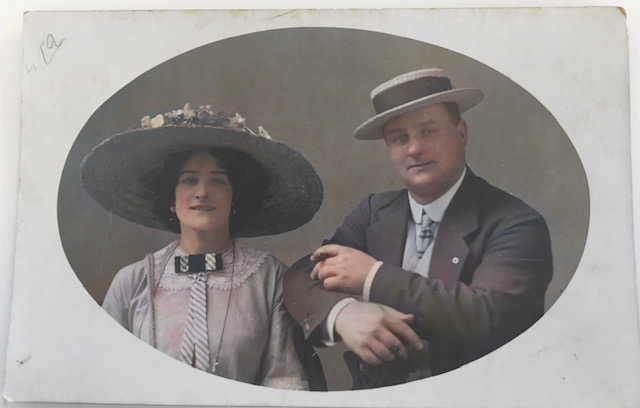
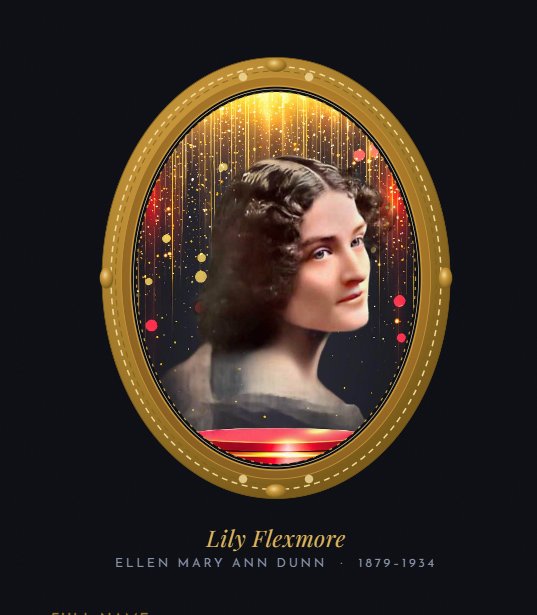
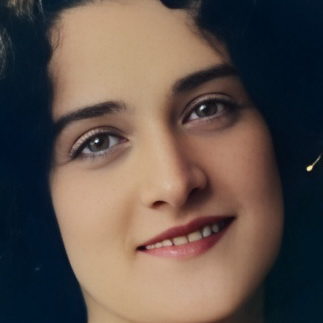
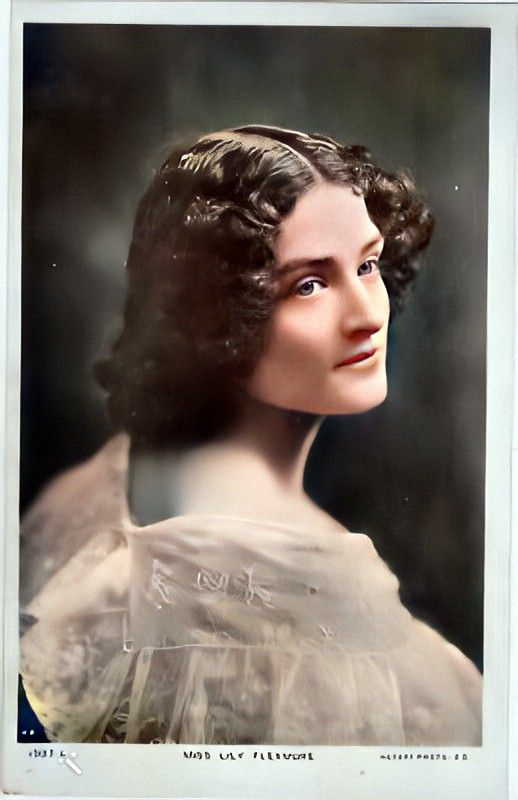
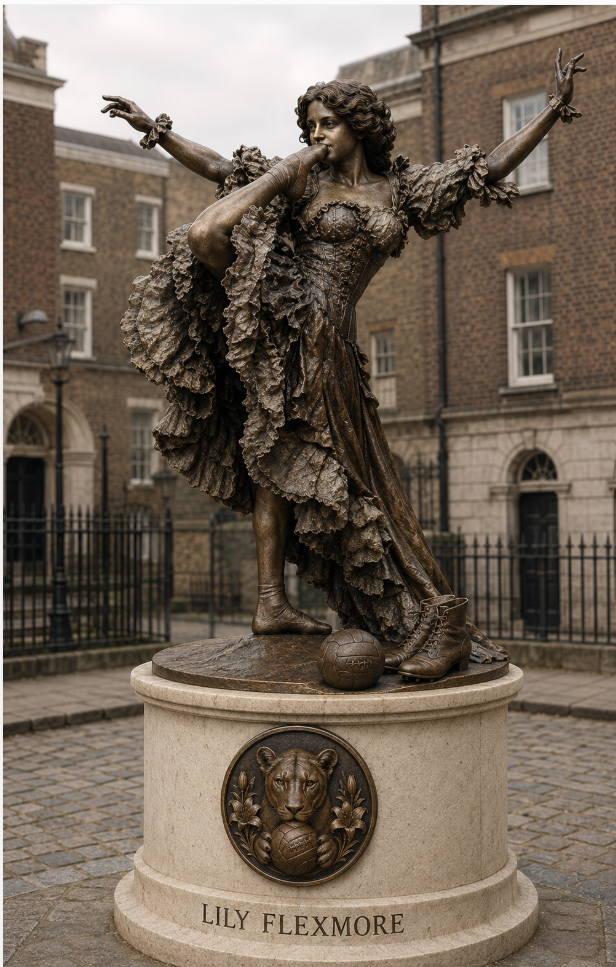
The search for Ellen Mary Ann Dunn - Ruth Coupland - Lily Flexmore began some twenty-five years ago.
Ellen’s great-great-niece, Ms Karen Wall, had heard the name mentioned by her grandmother, Ms Irene Dunn, who was the daughter of Ellen’s younger brother, George William Dunn. Karen’s grandmother spoke of going to the theatre as a young girl and described her excitement at seeing her auntie Ellen - Lily Flexmore’s - name up in lights. Karen decided to find out all she could about Ellen Dunn.
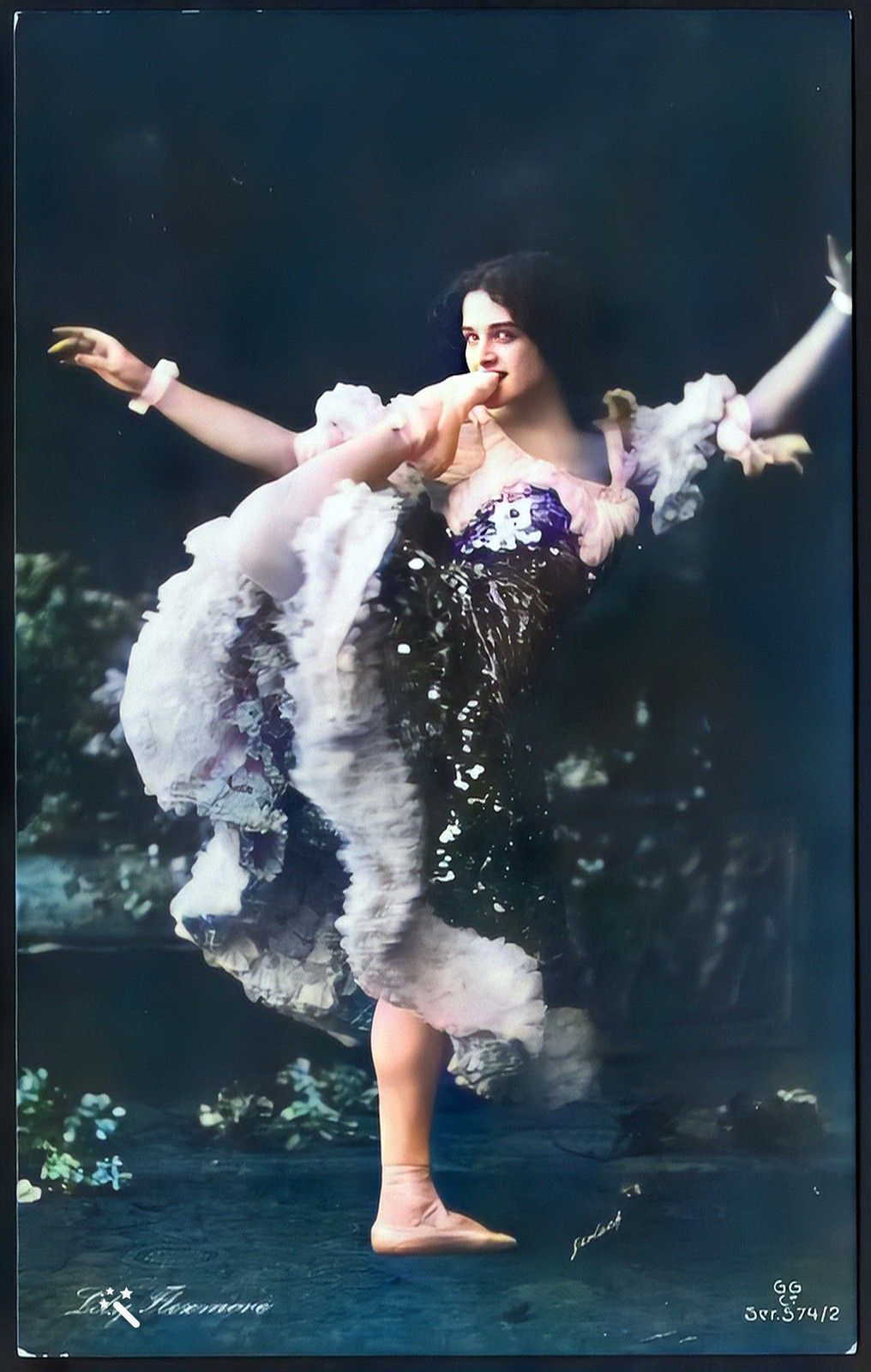
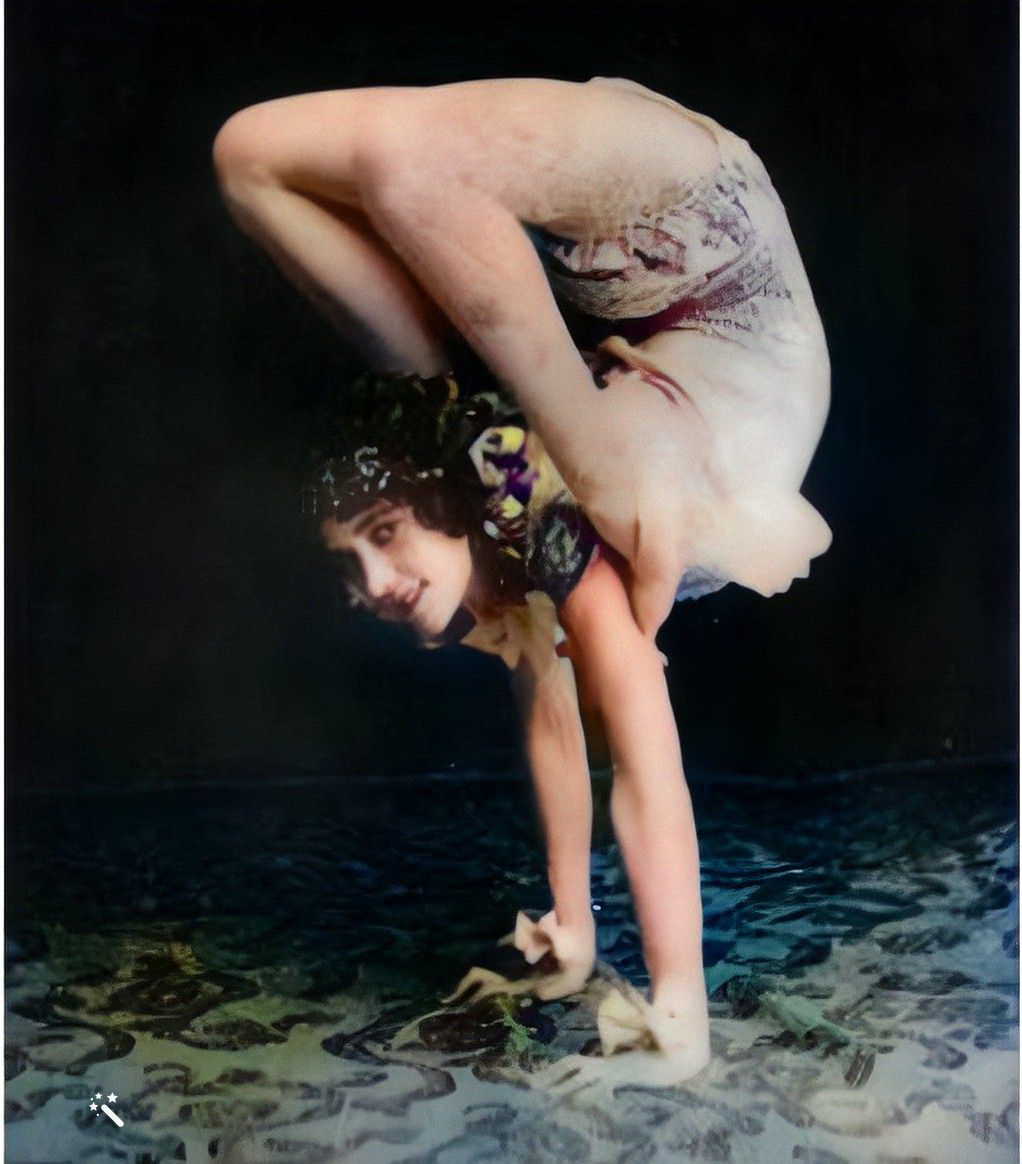
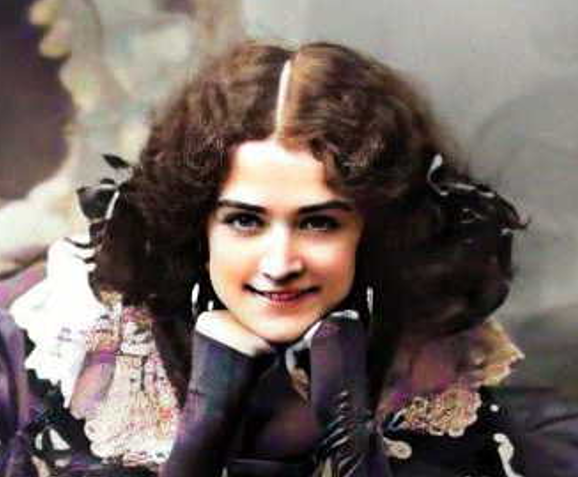
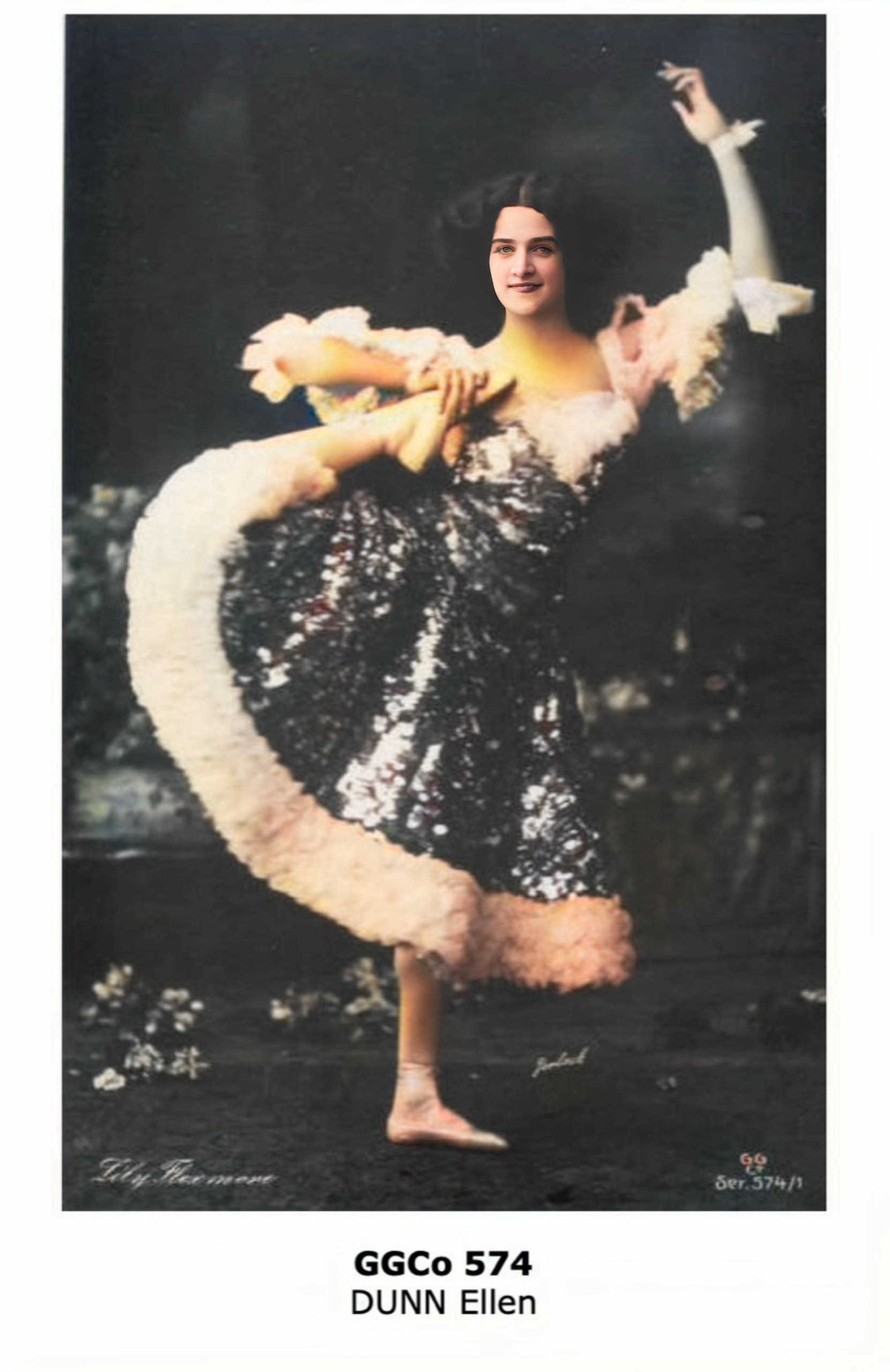
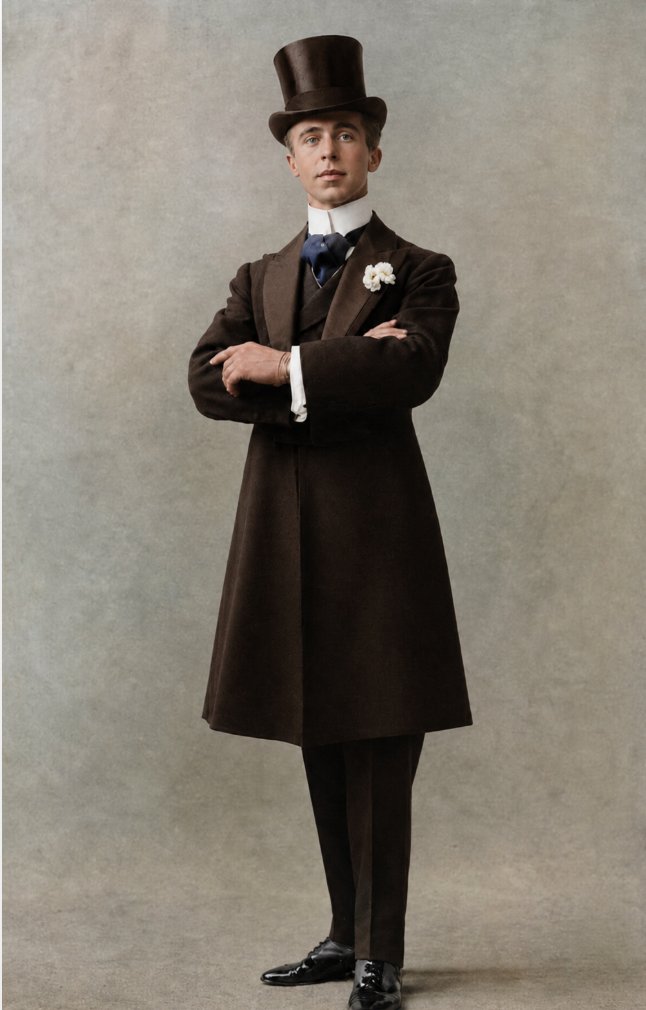
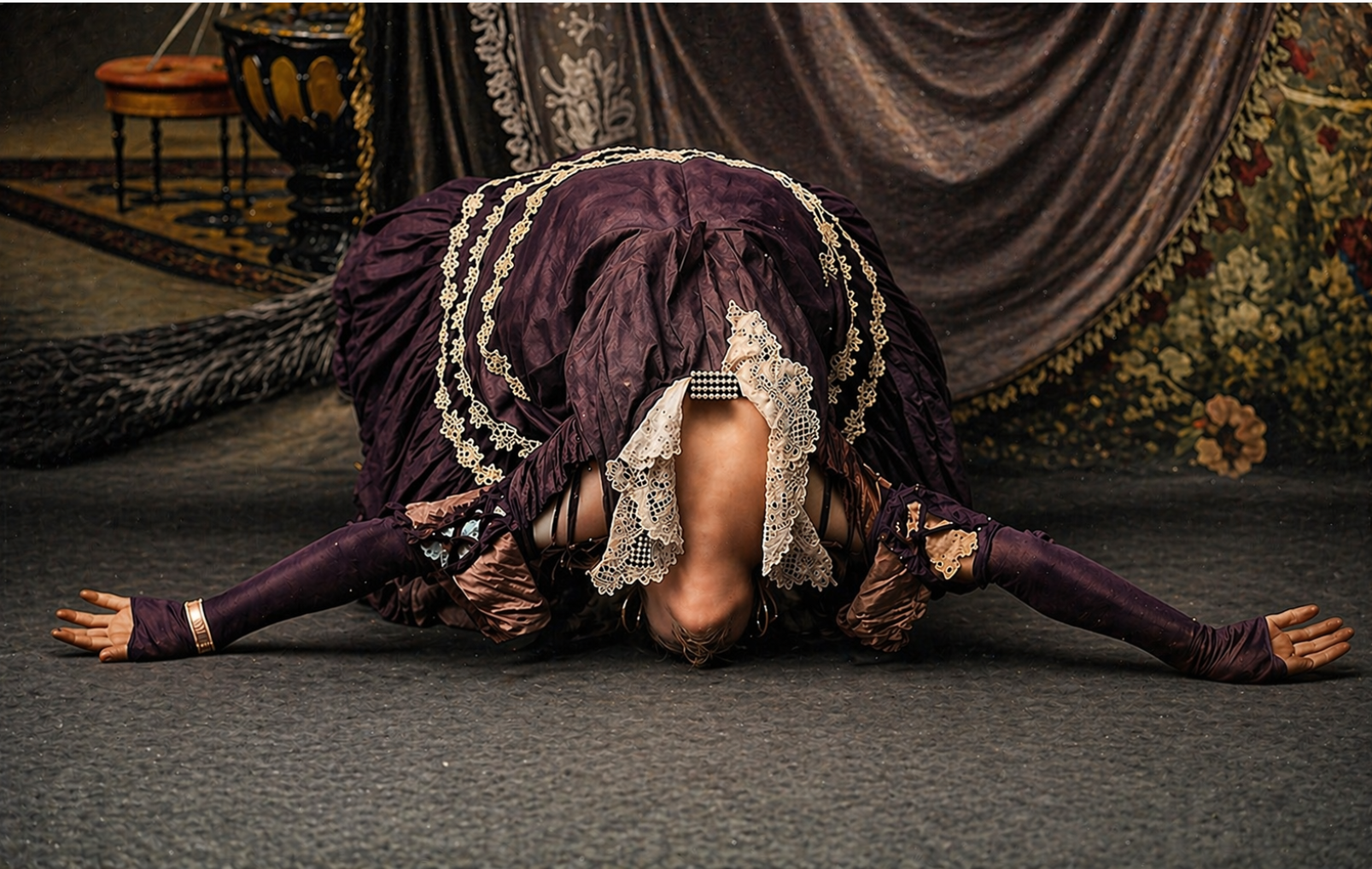
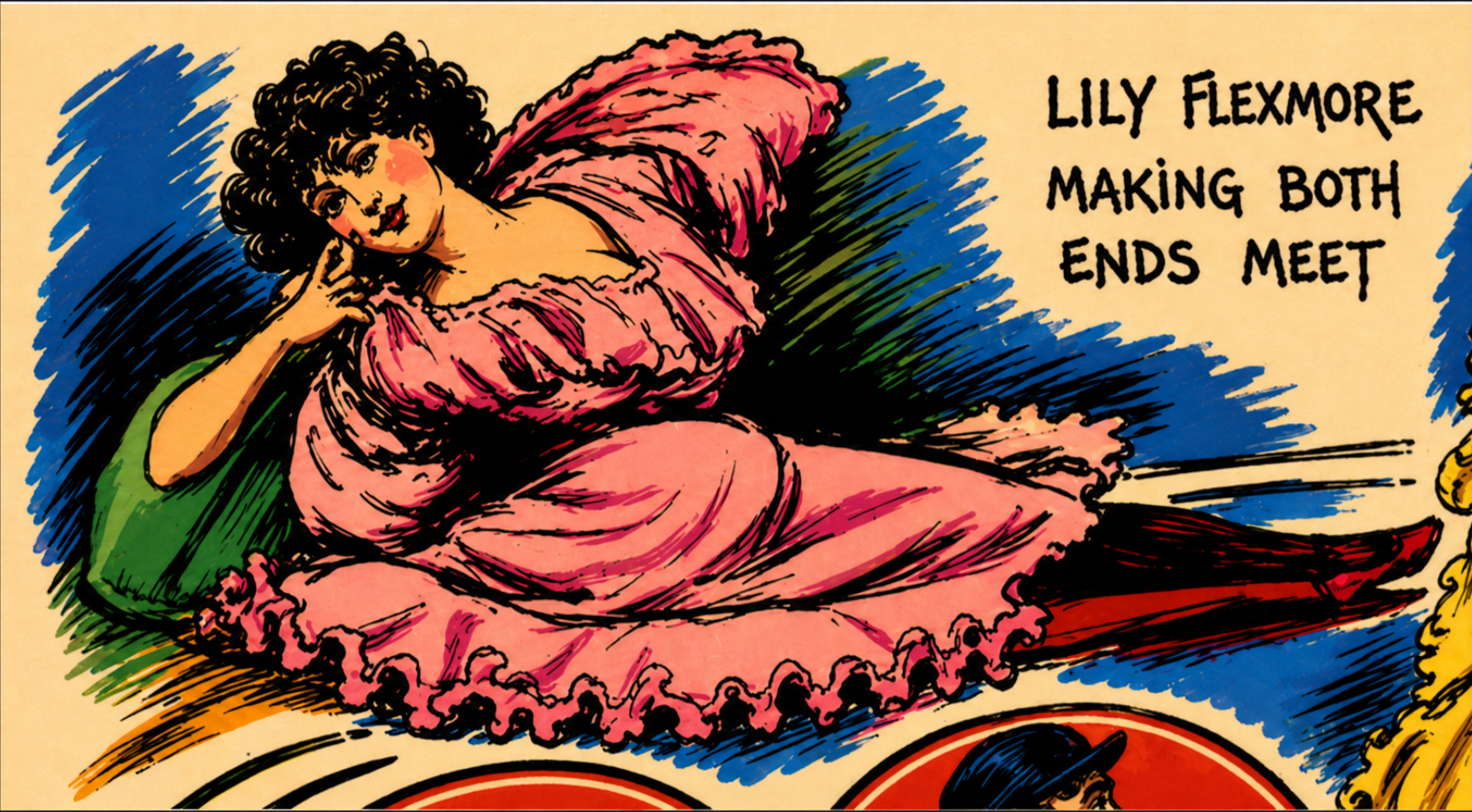
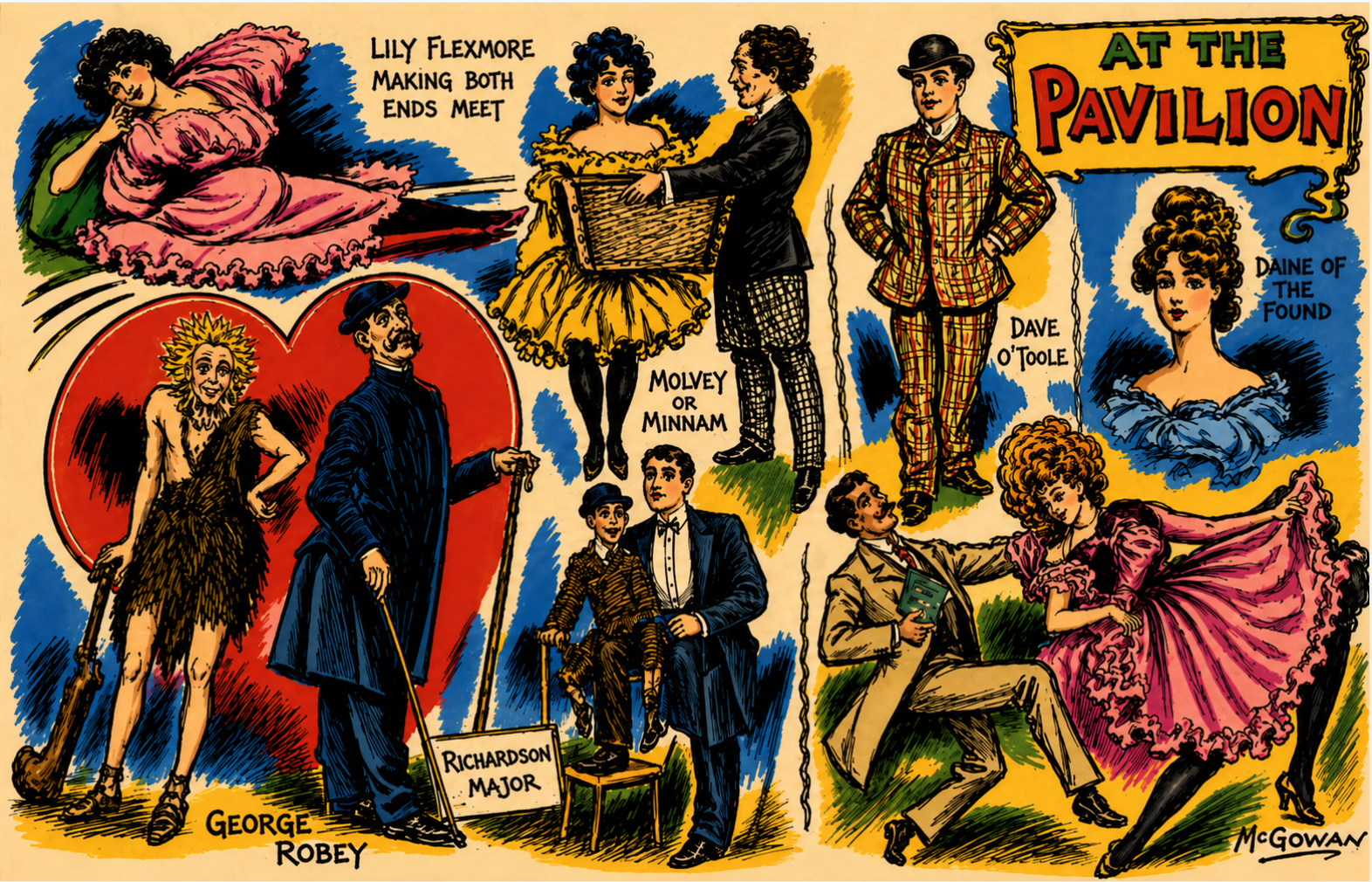
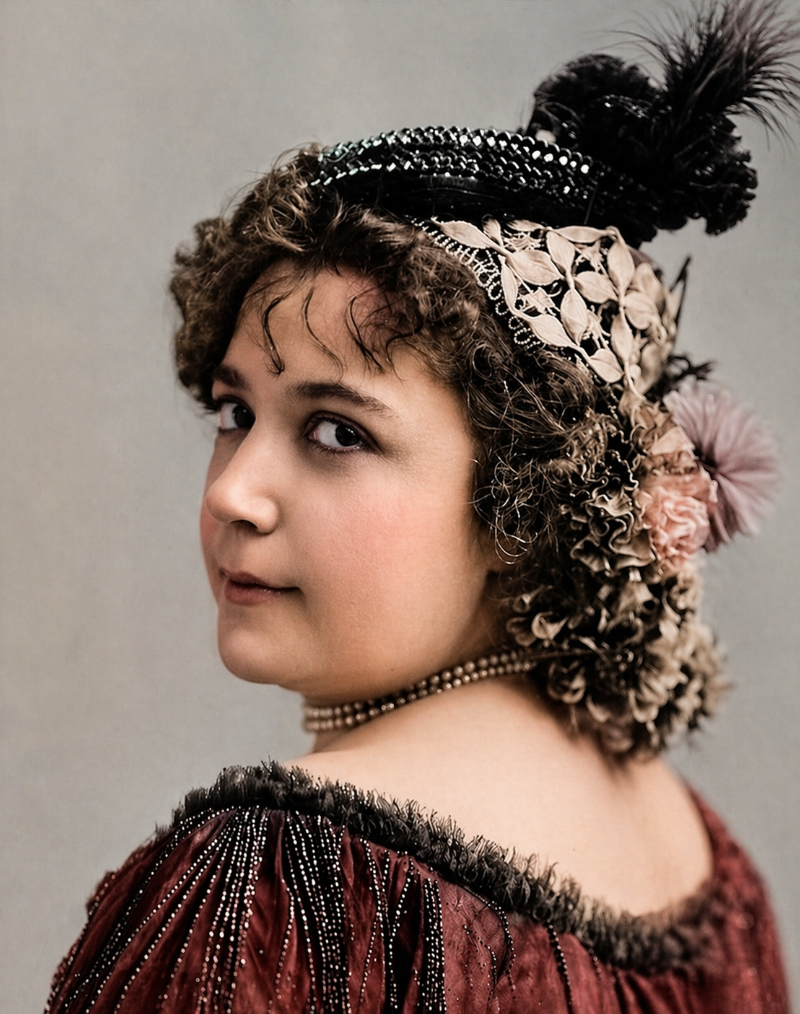
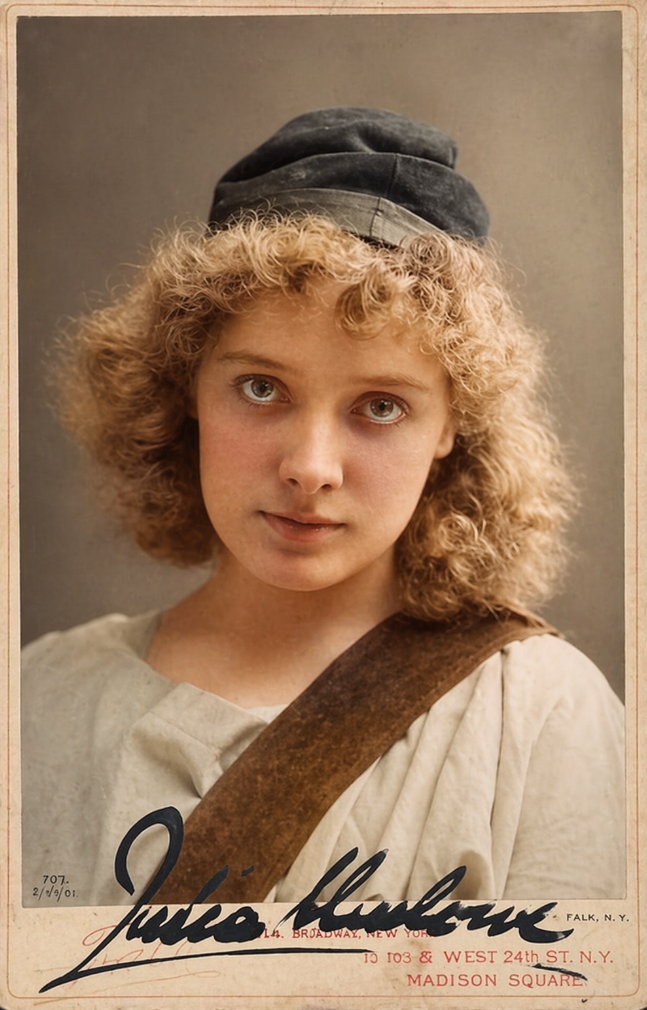
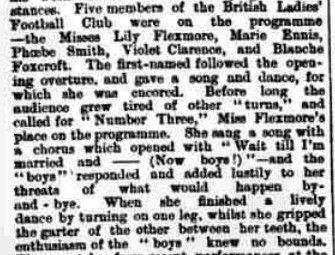
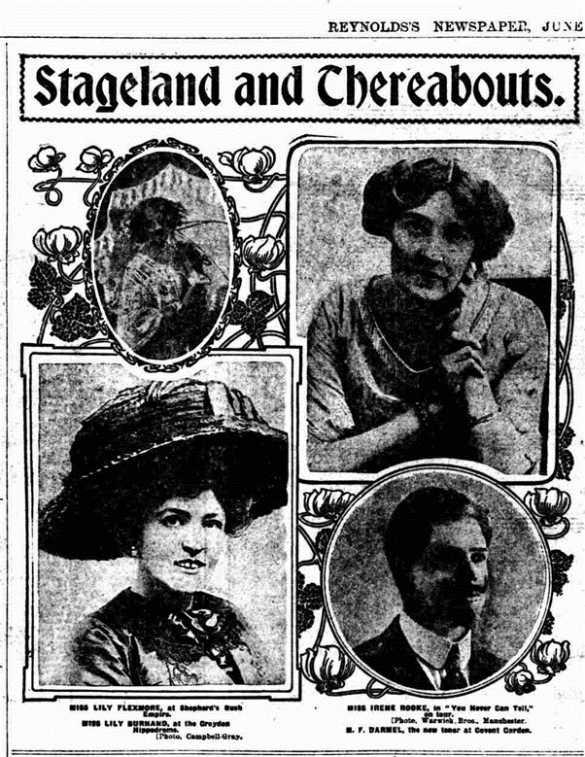
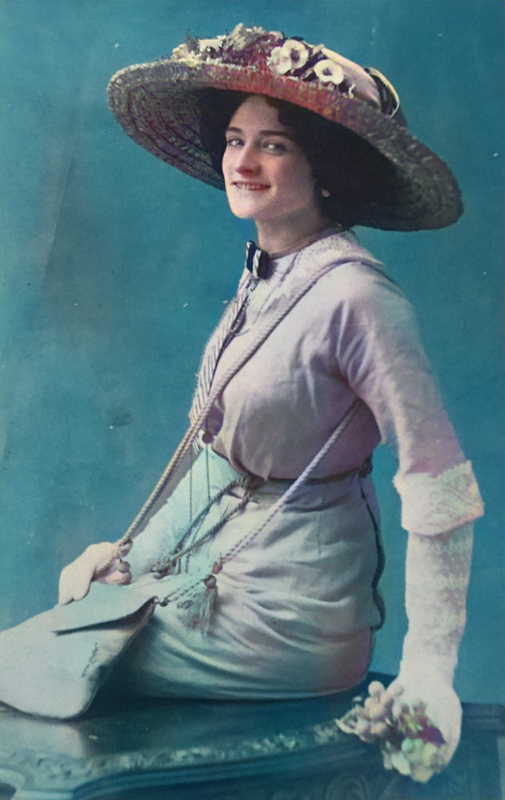
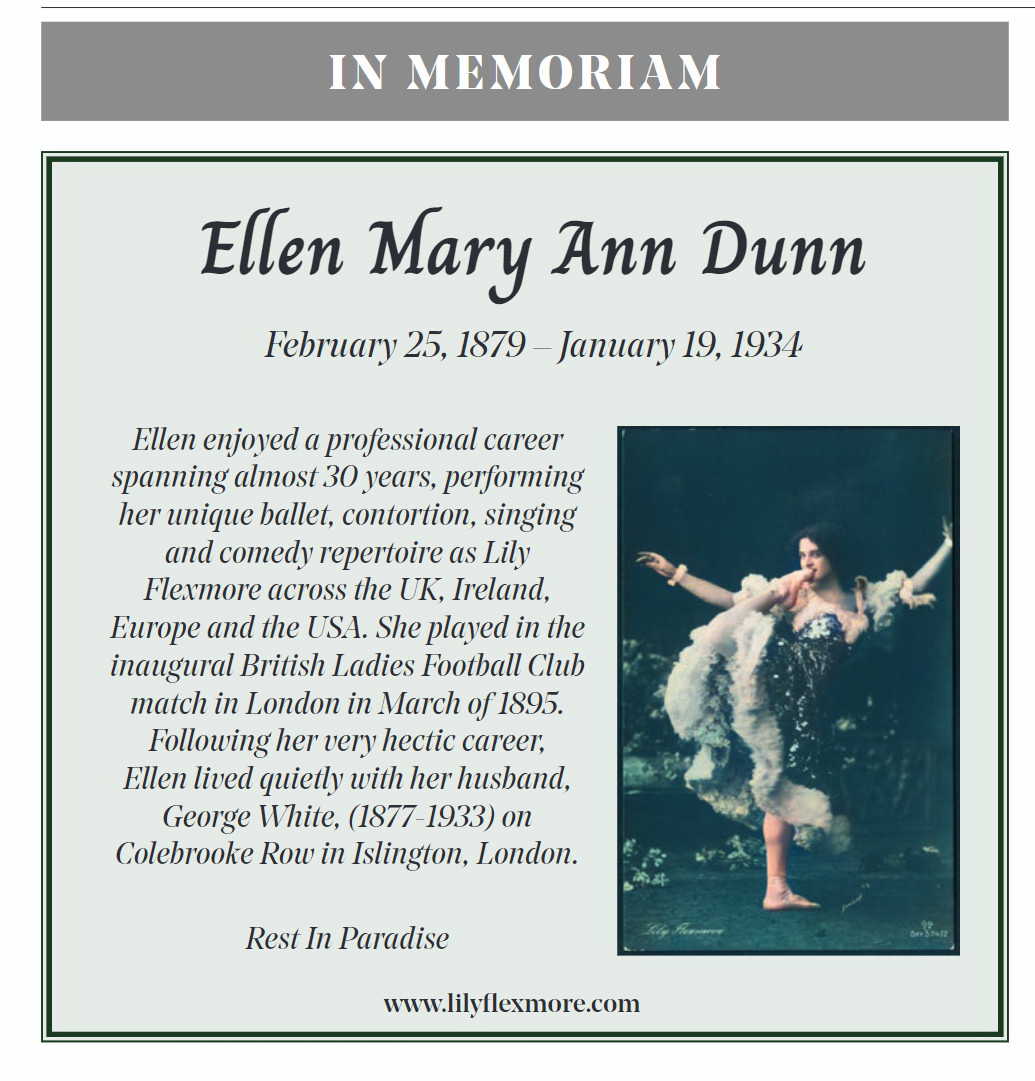
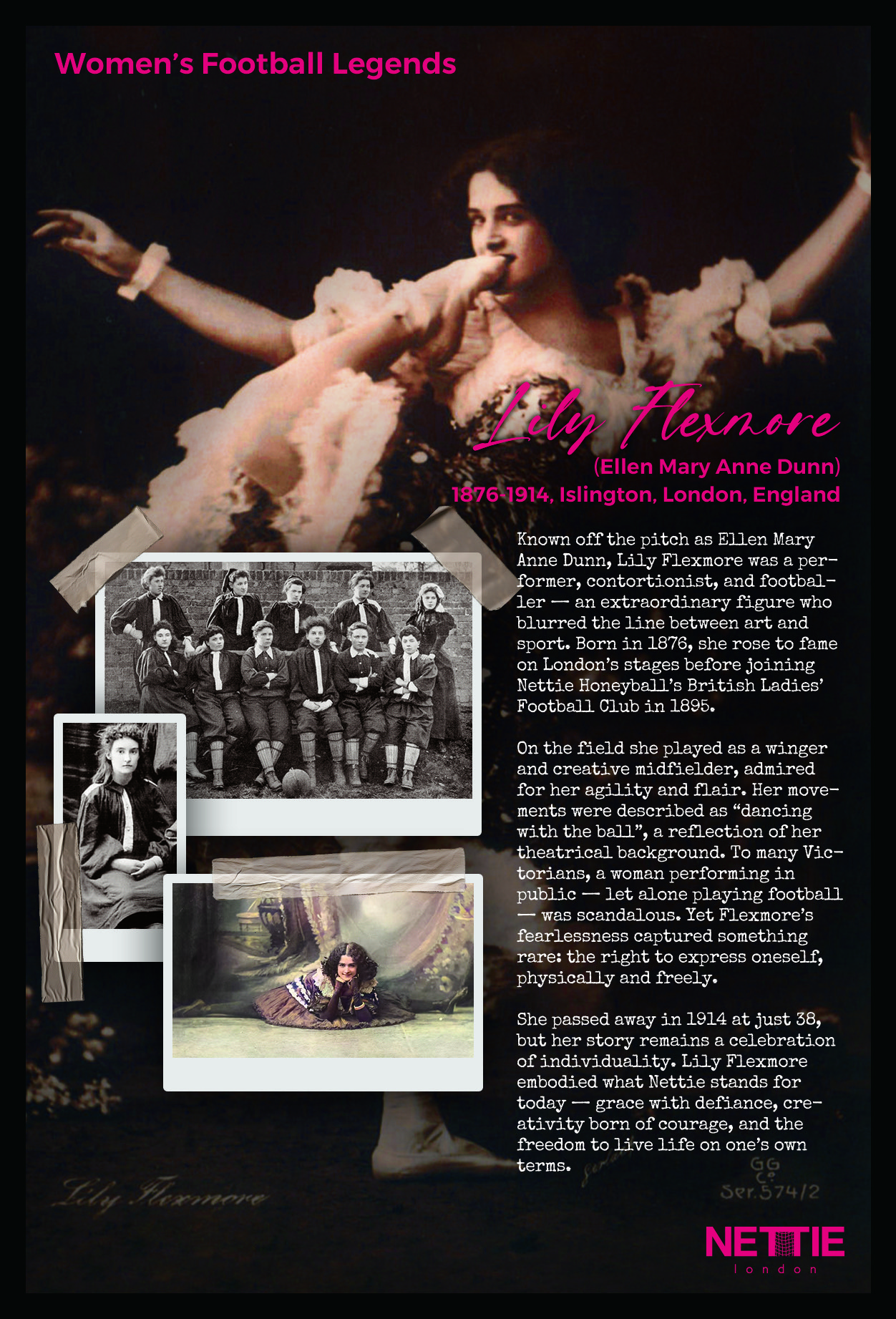
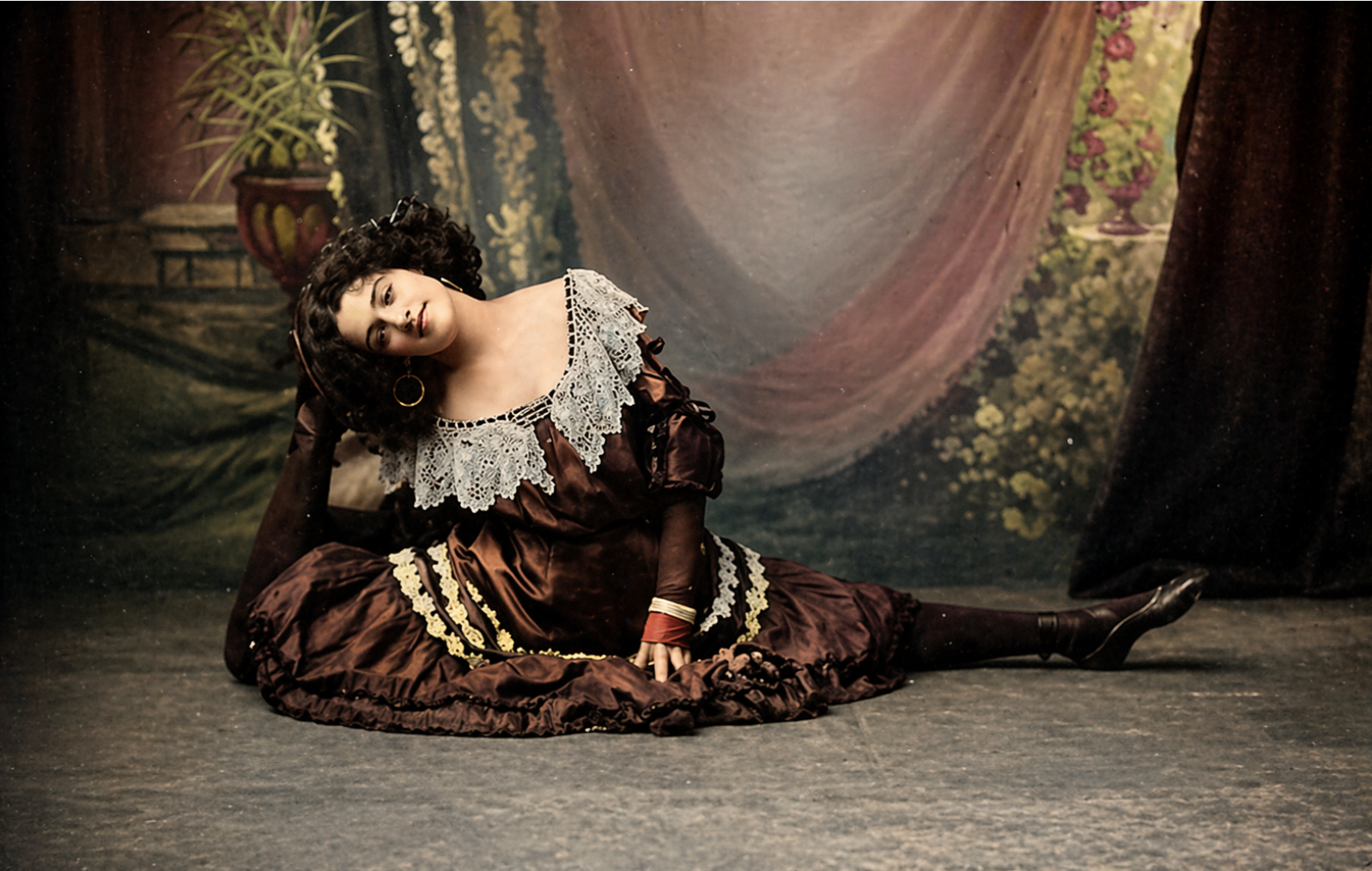
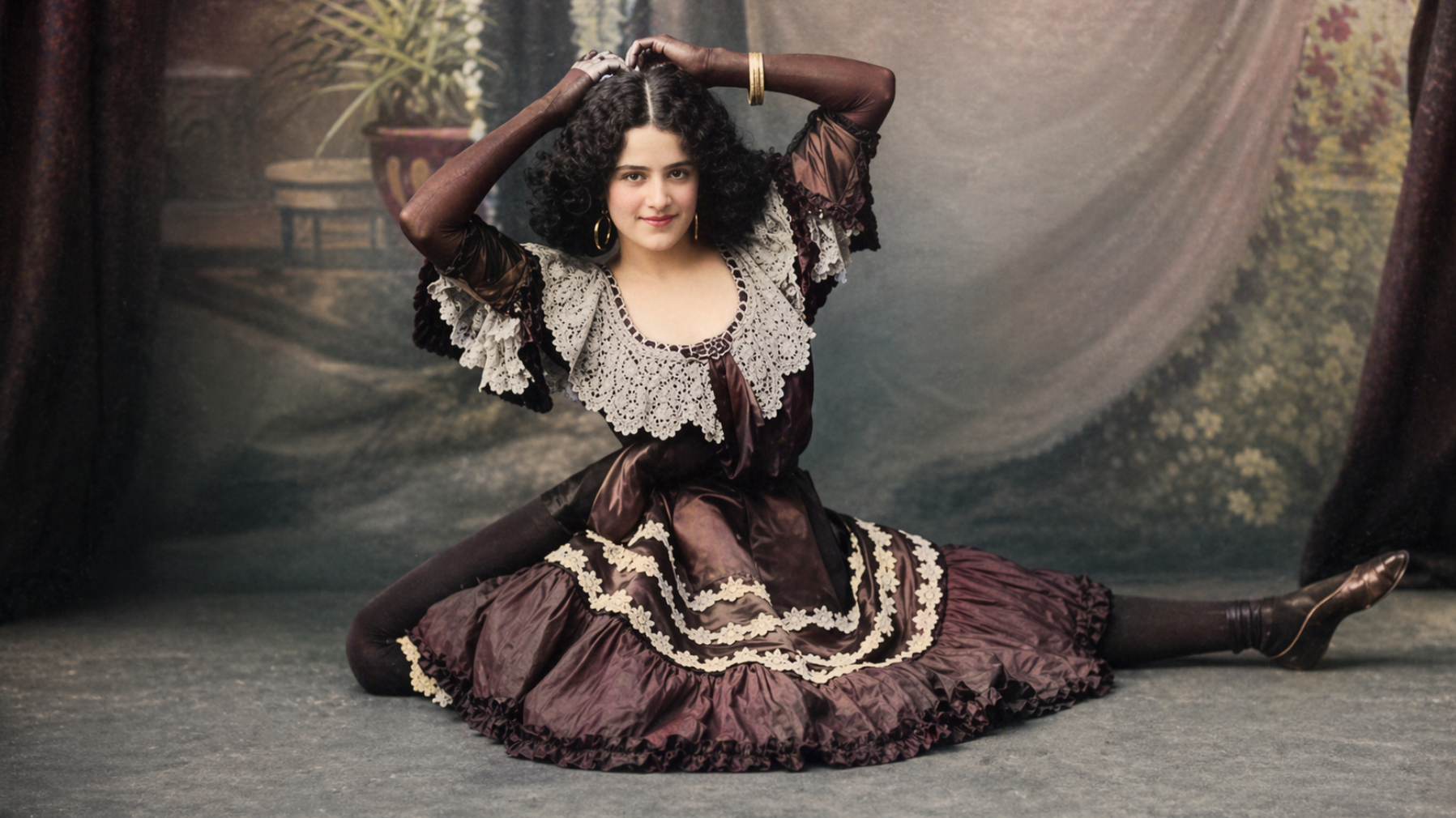
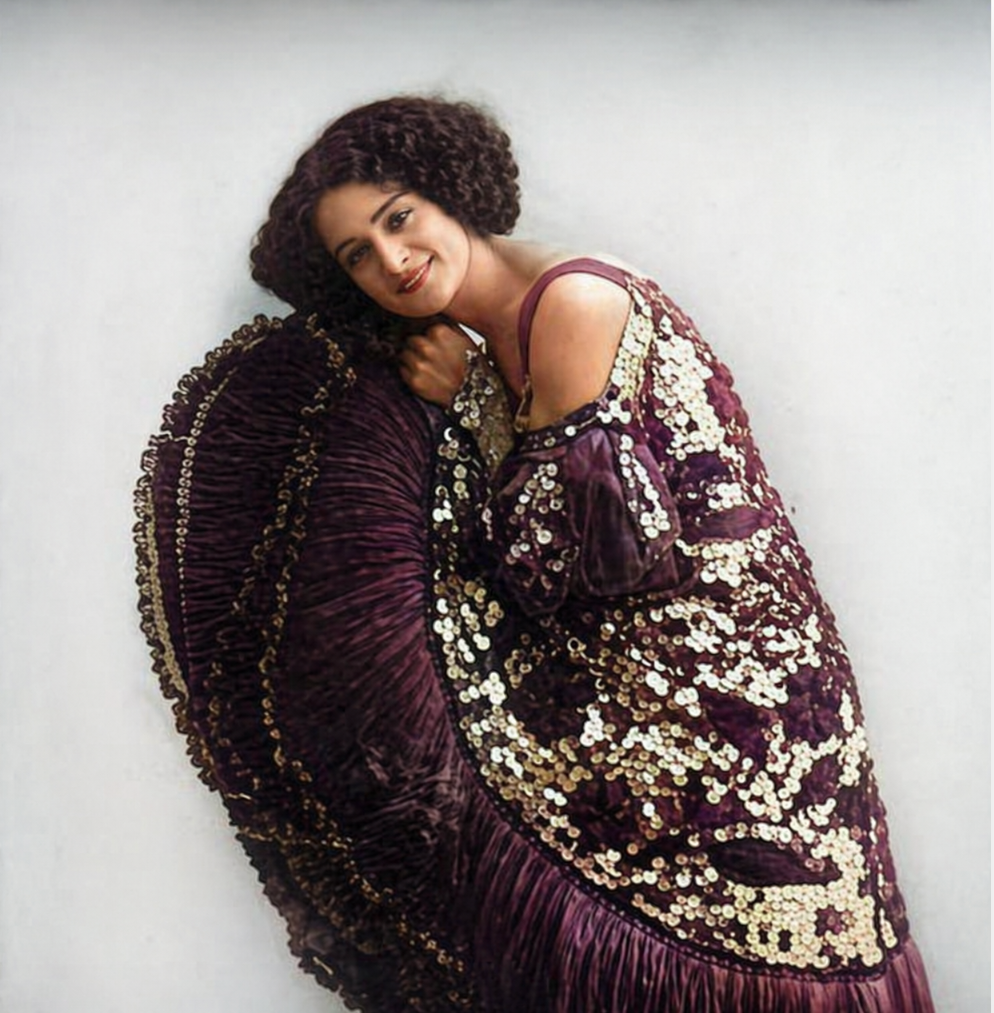
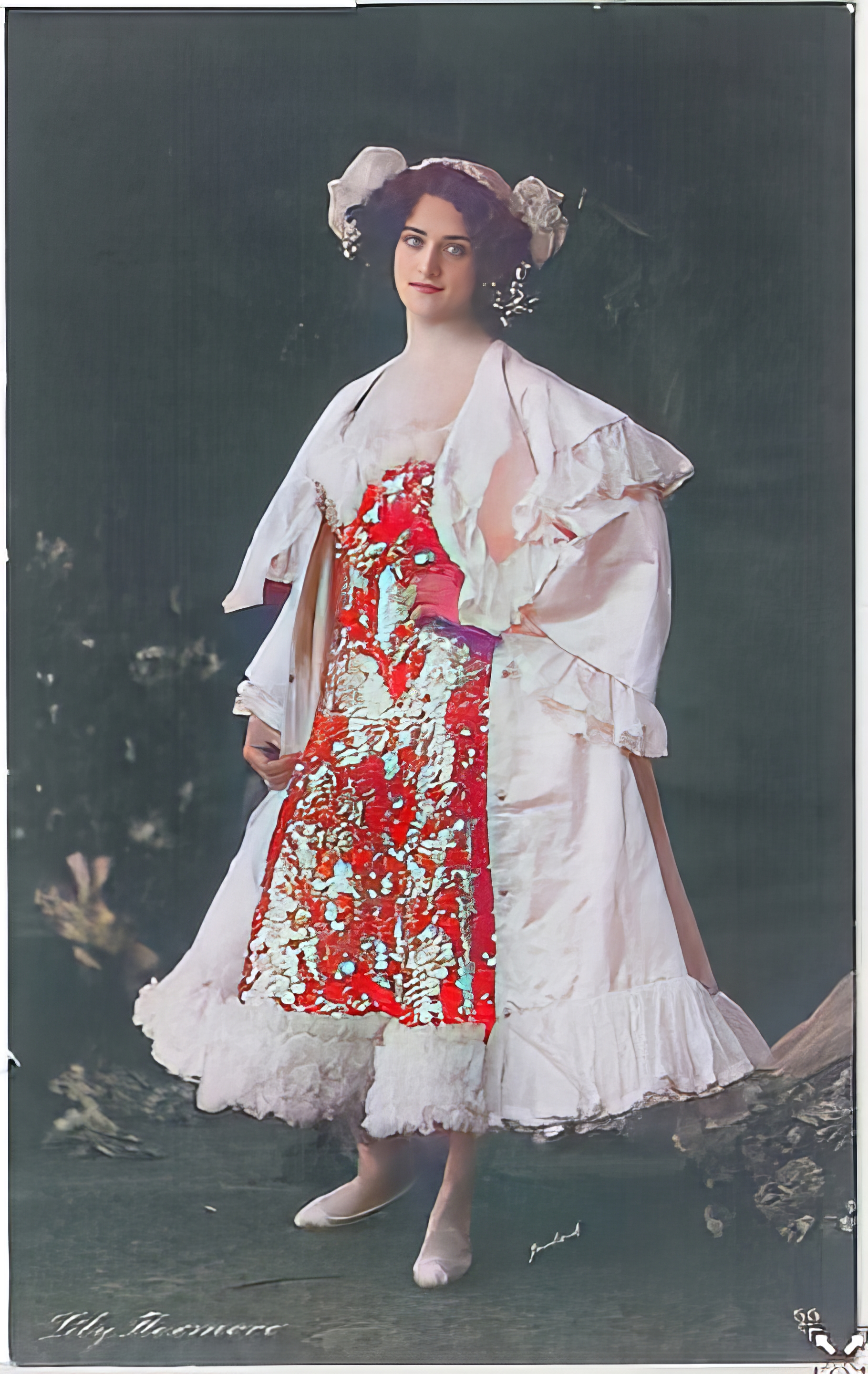
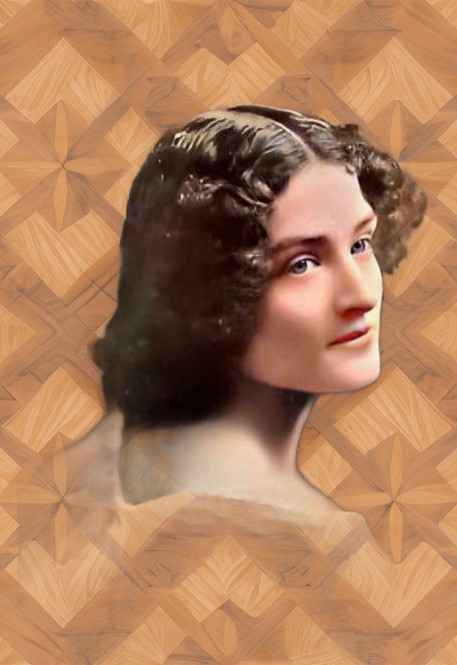
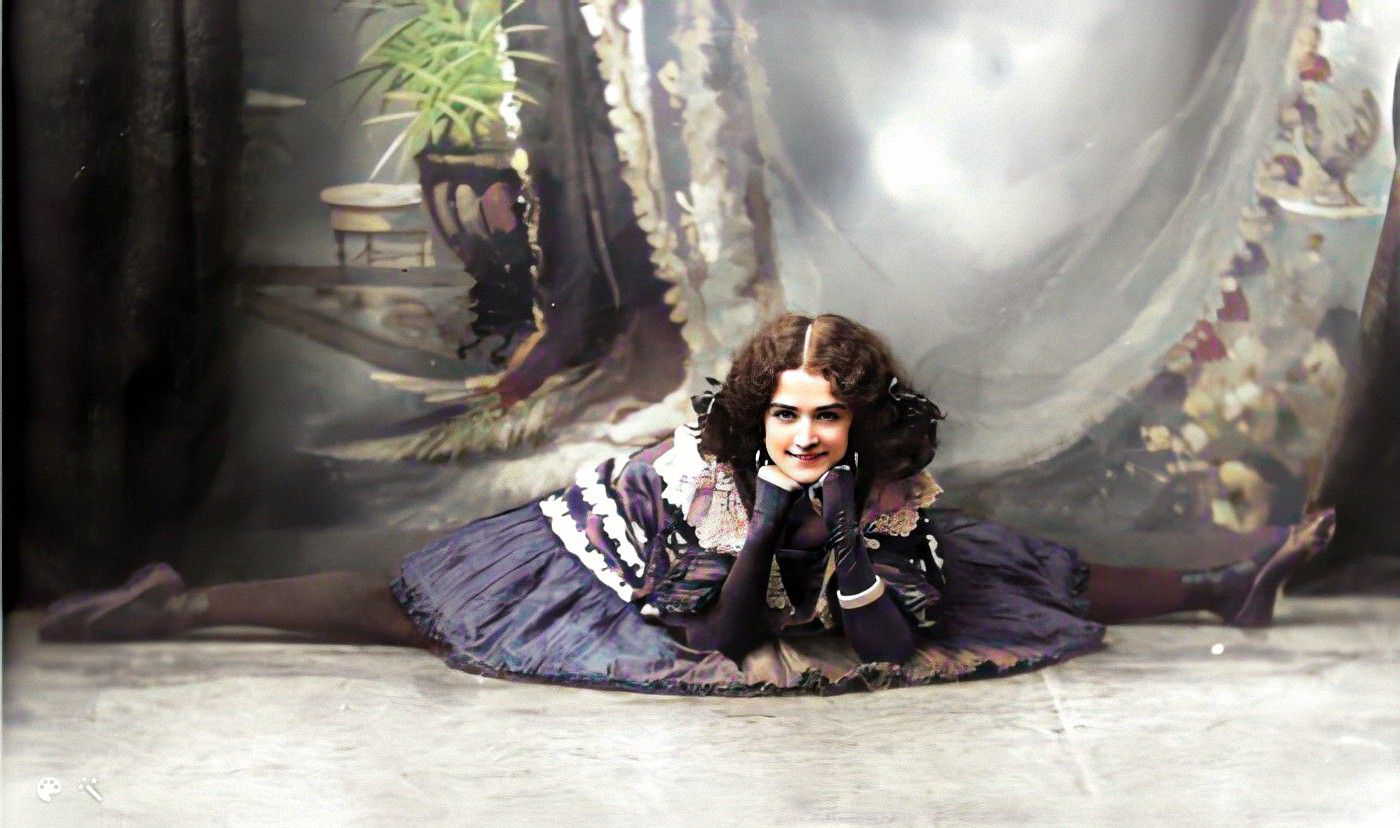
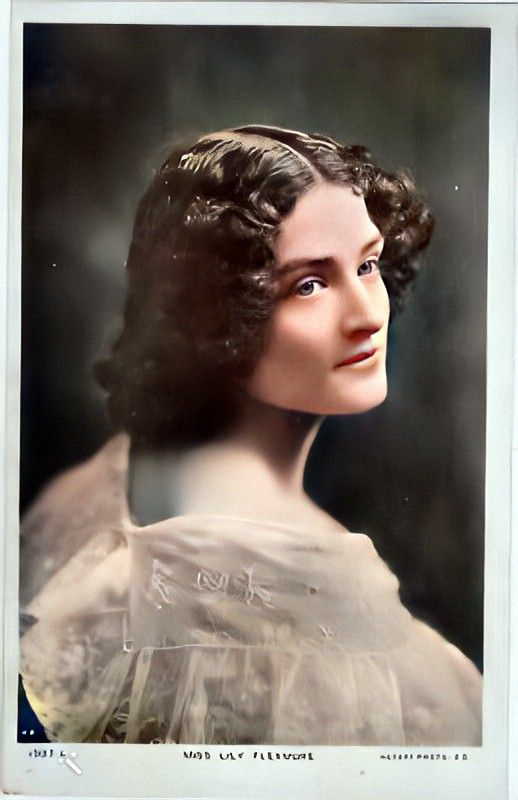
What was known about Ellen was that she had enjoyed a long career on stage as a dancer, singer and contortionist, later adding comedy to her act. There were some photos of Ellen in costume, posing for promotional pictures, shared with Karen by her relatives, Paul Duffett, Jill Adams and Catherine McBrearty. But nobody knew what became of Ellen. Had she married? When did she pass away? The last reference to her was in March of 1925, in a newspaper article which described her as still performing her signature ‘Toe-In-Mouth’ dance, at the age of forty-six.
Research, at that time, was difficult. Tracing family history required patience, persistence, and a willingness to navigate masses of physical records, scattered archives, and long waiting times. Rather than typing a name into a search bar, Karen needed to engage in a process that felt closer to detective work than data retrieval.
This meant spending a lot of time trawling through pre-digital records in libraries, courthouses, churches, and national archives. These institutions housed vital paper records such as birth certificates, marriage registers, census data, and land deeds. However, finding relevant material was rarely straightforward. Karen began with card catalogues - wooden drawers filled with index cards that pointed to collections of documents. From there, she needed to request access to specific materials, often stored on microfilm or in fragile paper form. Without comprehensive indexing, locating a single name could require hours of careful scanning.
Microfilm and microfiche machines were available, but it was necessary to sit at these machines, manually scrolling through frames of census pages, newspaper archives, or immigration records. The process was tedious and required intense focus; missing a detail could mean starting over. Writing letters to distant archives, churches, or government offices was a routine part of the process - these requests often included small fees and self-addressed stamped envelopes, and responses could take weeks or even months, if they arrived at all.
Although the process was time-consuming and often uncertain, Karen maintains that it offered a unique sense of connection to the past. Handling original documents, visiting ancestral locations, and uncovering stories piece by piece created a tangible link to real history. Each discovery felt significant precisely because it required effort and dedication.
In 2020, I began to research Lily Flexmore for an entirely different reason. A granduncle of mine, Matthew Mooney (1892–1942), had married Eva Matilda Knight (1884–1951) at the Church of St. Mary, Edenderry, Co. Offaly, in November 1913. Eva’s occupation on the marriage certificate reads: Travelling Theatre Artiste. She had been born in Shrewsbury in 1884 - her birth certificate names her father as Frederick Edward Knight, Artiste, and her mother as Sophia Matilda Gilleno Giles. Her paternal grandfather was Thomas Knight, known professionally as ‘Flexible Flexmore’ - an exponent of legmania and physical contortion of the highest order. Her mother Sophia performed as an Equestrienne under the name Marie Flexmore. The 1911 Irish Census finds the whole family at Pound Lane, Clogheen, Tipperary - the dwelling listed as a Bazaar - all of them recorded under the Flexmore surname. Searching for Eva was what first led me to Lily Flexmore. Was there a connection between Ellen Dunn and this same performing dynasty? Eva was British, born in Atcham, Shrewsbury. The possibilities were real.
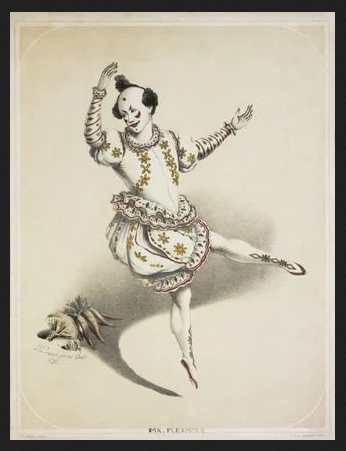
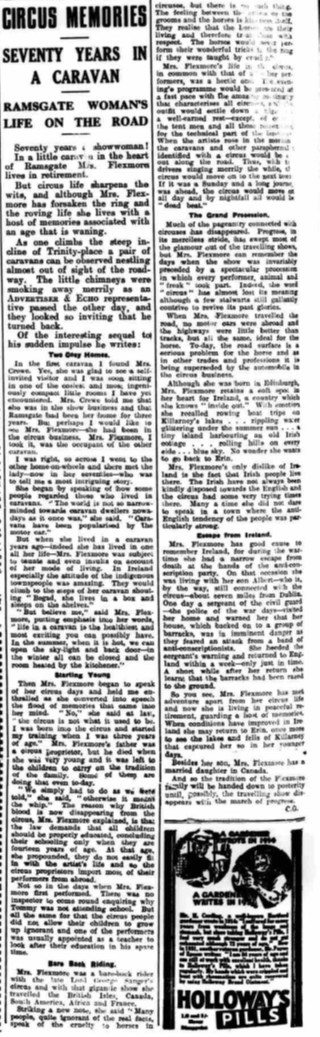
The more I researched, the more I came to understand that Flexmore was not simply a stage name. It was something closer to a professional designation of the highest order - a signal, understood throughout the Victorian performing world, that the bearer had been trained to an exceptional standard in physical theatre. Thomas ‘Flexible Flexmore’ Knight carried it as a performer. His daughter-in-law Sophia Matilda Gilleno carried it as Marie Flexmore, touring with the legendary Lord George Sanger’s Circus from the age of three. In 1934, by then in her seventies, Sophia was still being interviewed about her extraordinary life on the road - the Thanet Advertiser & Echo marking the occasion with the headline “Seventy Years a Show-woman.” The Flexmore name, she made clear, meant something. It had always meant something.
Contemporary press confirms how widely that meaning was understood. A review of an equestrian ballet at the Royal Amphitheatre describes one Charles Lauri - later celebrated as the ‘Garrick of Animal Mimes’ and a fixture of Victorian pantomime at Drury Lane - as “a gymnast of the Wieland and Flexmore school.” The Wieland referred to was William Henry Wieland, performer and impresario, whose H. W. Wieland (Zaeo) Agency, established 1870, placed artists for stage and screen productions well into the twentieth century. That a journalist could invoke the Wieland and Flexmore school as a recognised institution - a shorthand that audiences and editors would immediately understand - speaks to the prestige the name commanded in Victorian London’s performing world.
Against this backdrop, Ellen Dunn’s choice of the name Lily Flexmore in 1896 takes on a deeper significance. She was not simply adopting a colourful pseudonym. She was, in effect, presenting herself to the world as a graduate of a tradition - claiming her place within a lineage of physical performers whose name alone communicated extraordinary skill. Whether she trained directly within the Wieland-Flexmore tradition, or simply understood its weight and chose accordingly, remains to be confirmed. But the name she chose was not arbitrary. In the Victorian performing world, it never was.
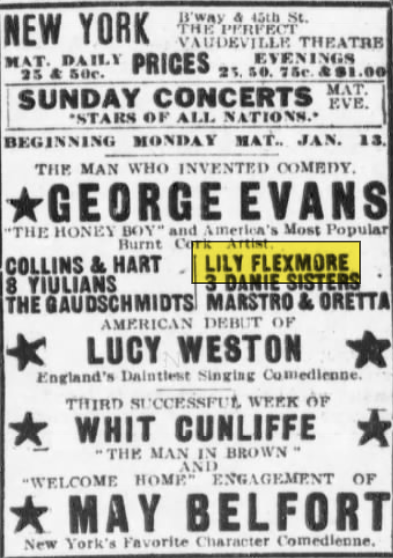
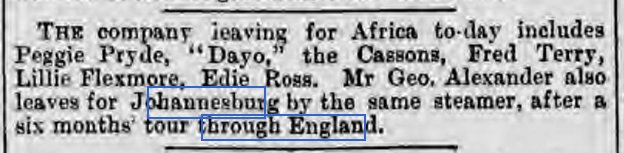
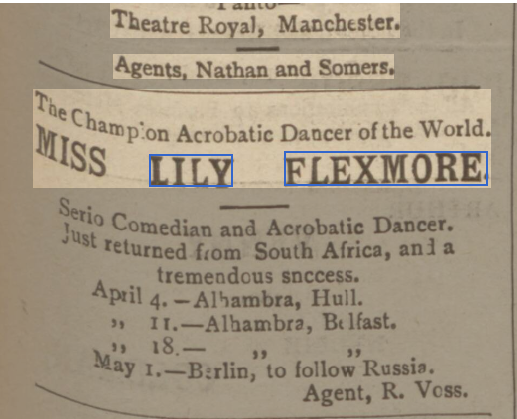
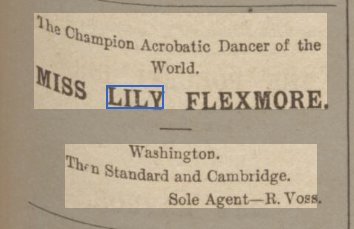
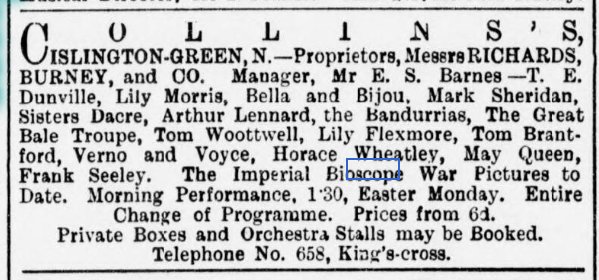
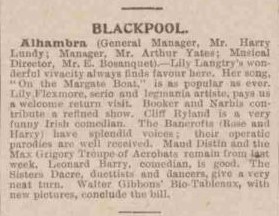
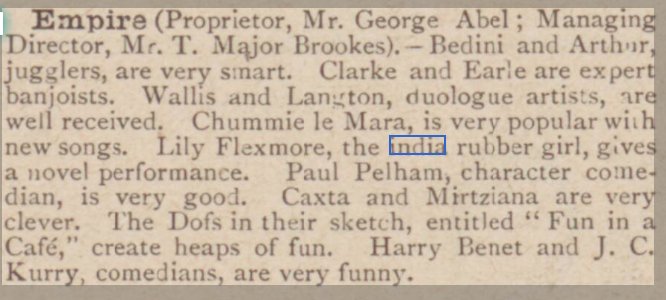
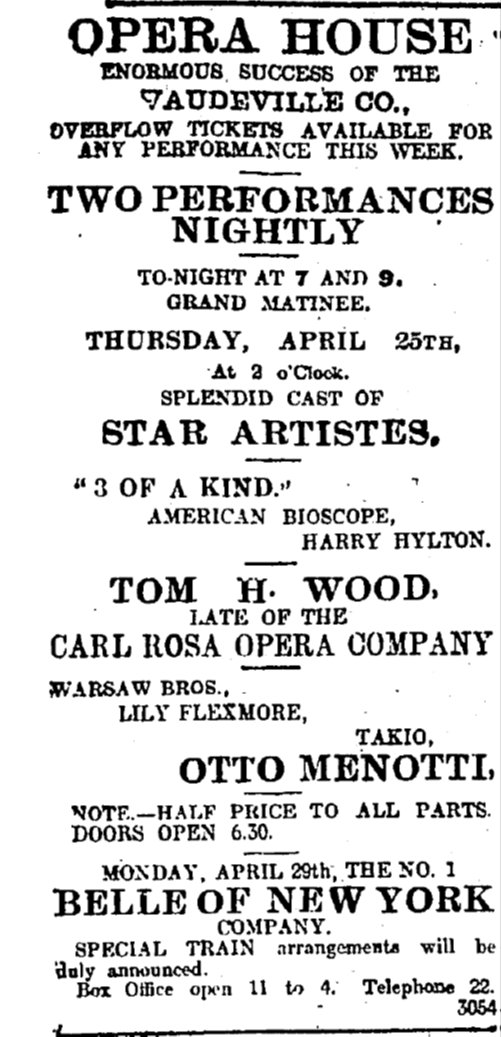
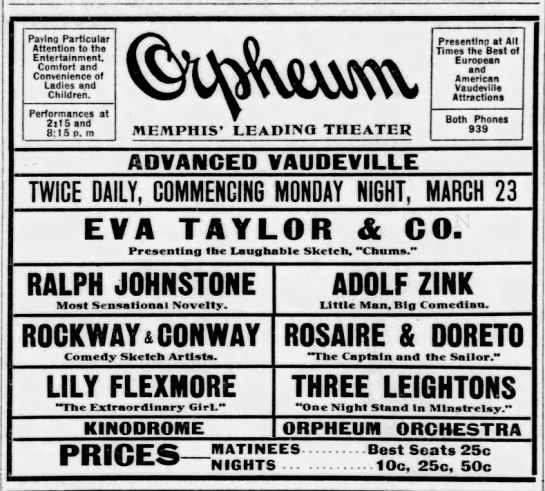
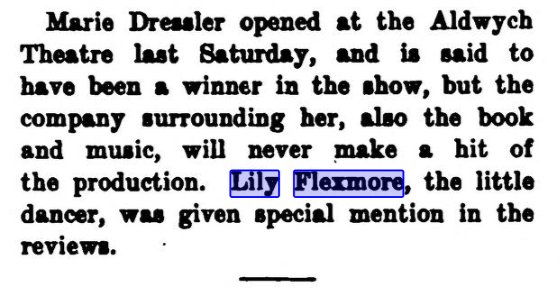
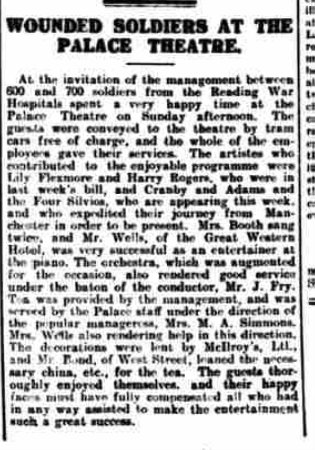
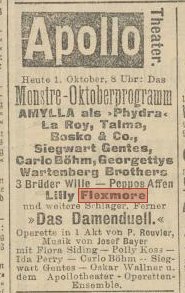
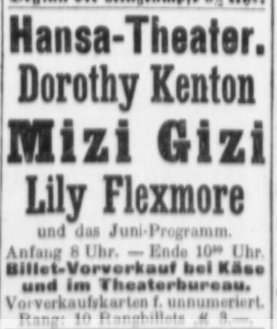
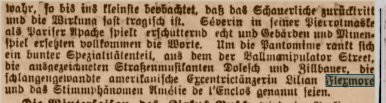
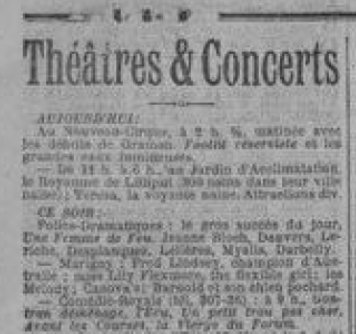
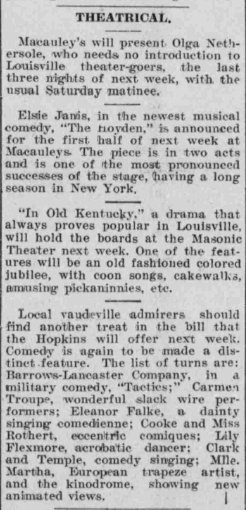
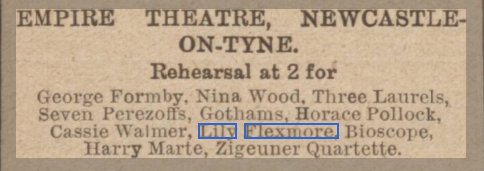
A search of the British Newspaper Archives alone revealed well over two thousand instances of promotional material, advertisements and playbills of the Lily Flexmore name between 1898 and 1925. Then there were records of her voyage to New York in December of 1907 with a George Flexmore for a lengthy tour of the United States, followed by a long European tour, with a return to performances in the UK in September of 1908.
I began to build an Ancestry Tree on Ellen Dunn and her family, making it a Public Tree in the hope that others might also be searching and would possibly have more information. I did manage to find a particular photo of Lily Flexmore in a very difficult contortionist pose, and when I added this to her tree, I received a message through the Ancestry system from a Ms Karen Wall in relation to the photo. I was thrilled to find out that Karen is the great-great-niece of Ellen Dunn/Lily Flexmore. This began a collaboration between Karen and I in the search for Lily Flexmore.
However, extensive searching yielded nothing further than newspaper publicity up to 1925. We had hit the proverbial genealogical ‘Brick Wall.’ Why had things suddenly come to an apparent halt? This was a woman who was seldom out of newspaper advertisements and theatrical magazines. Had something happened to Ellen? Had she perhaps left the country to pursue her career elsewhere?
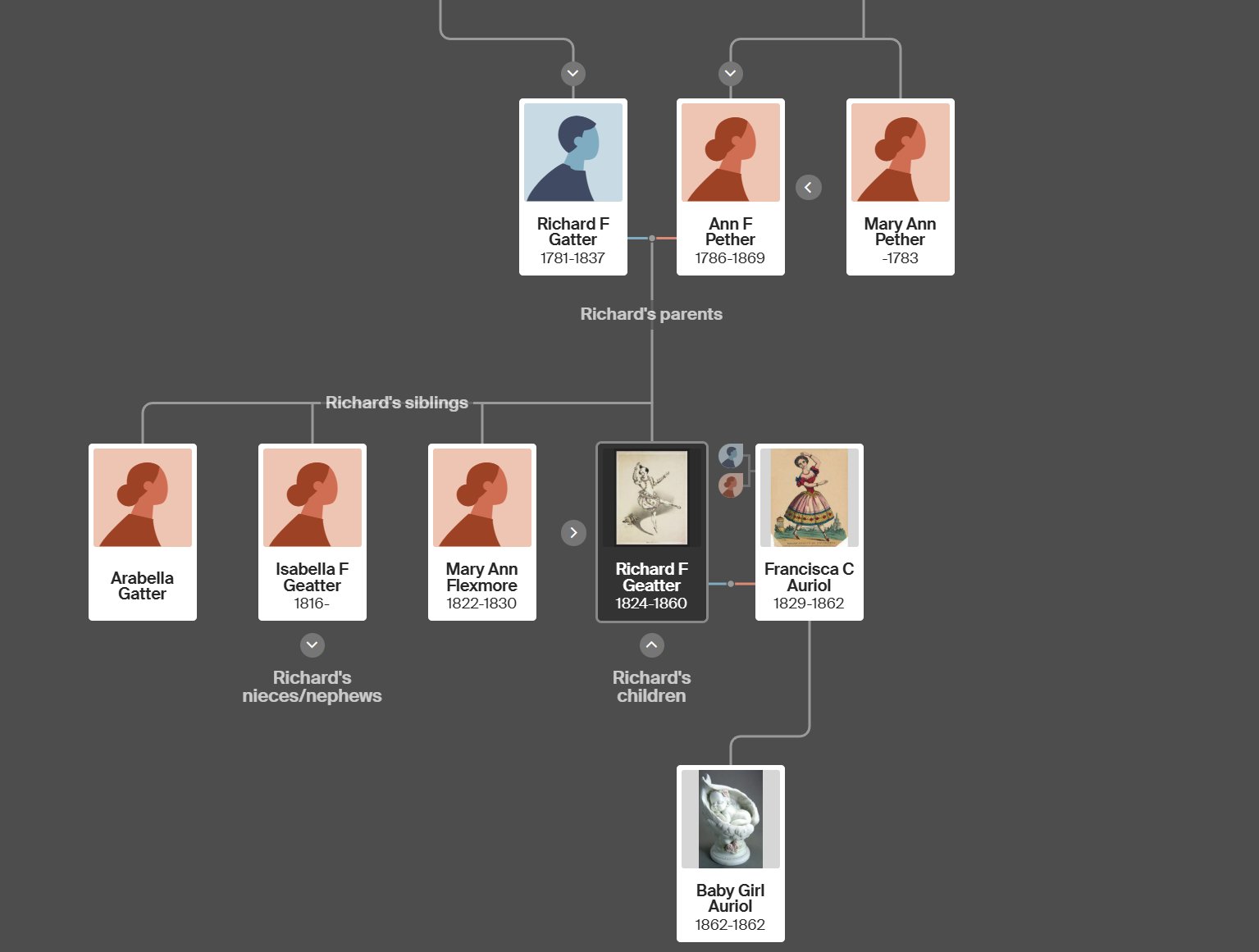
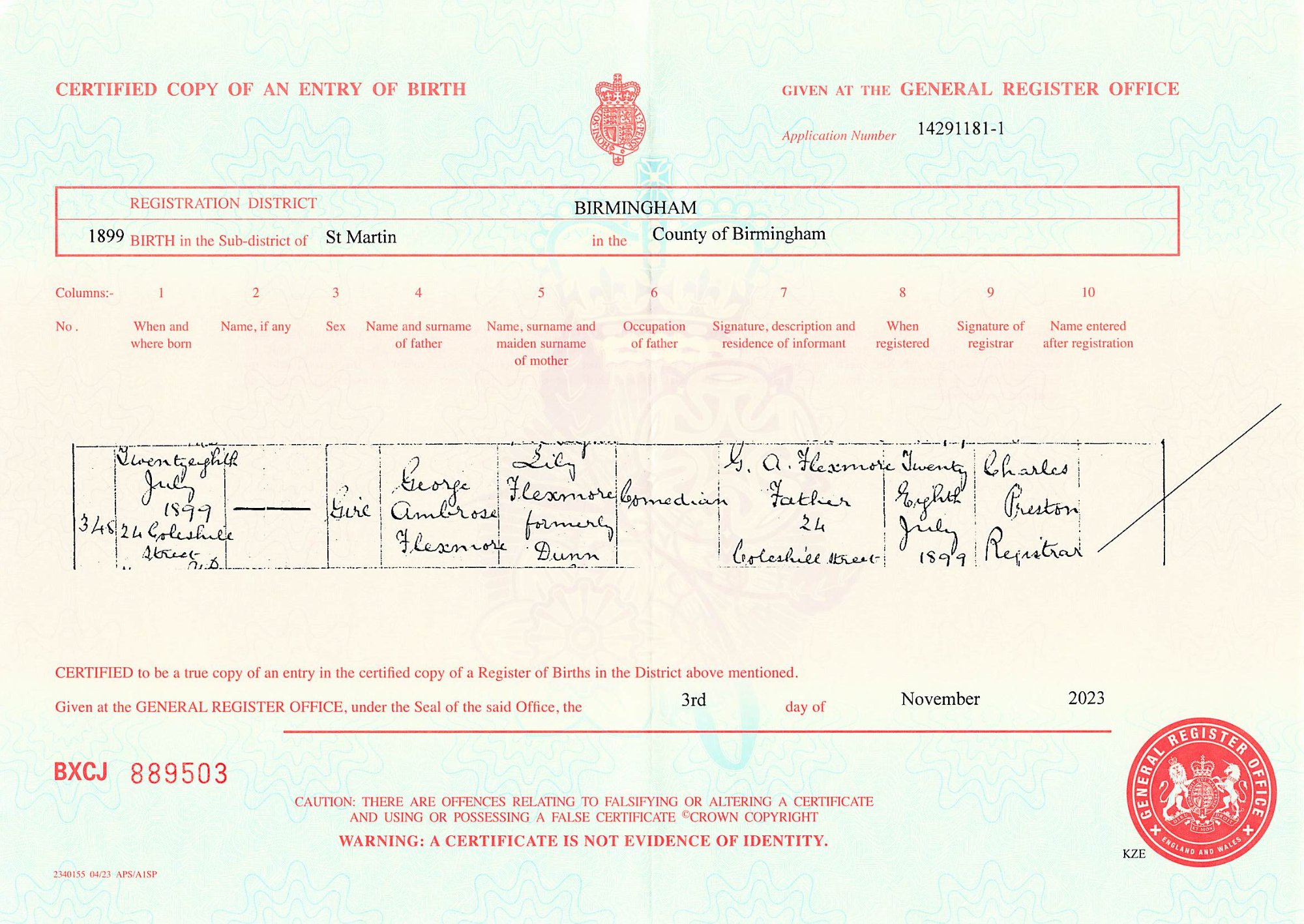
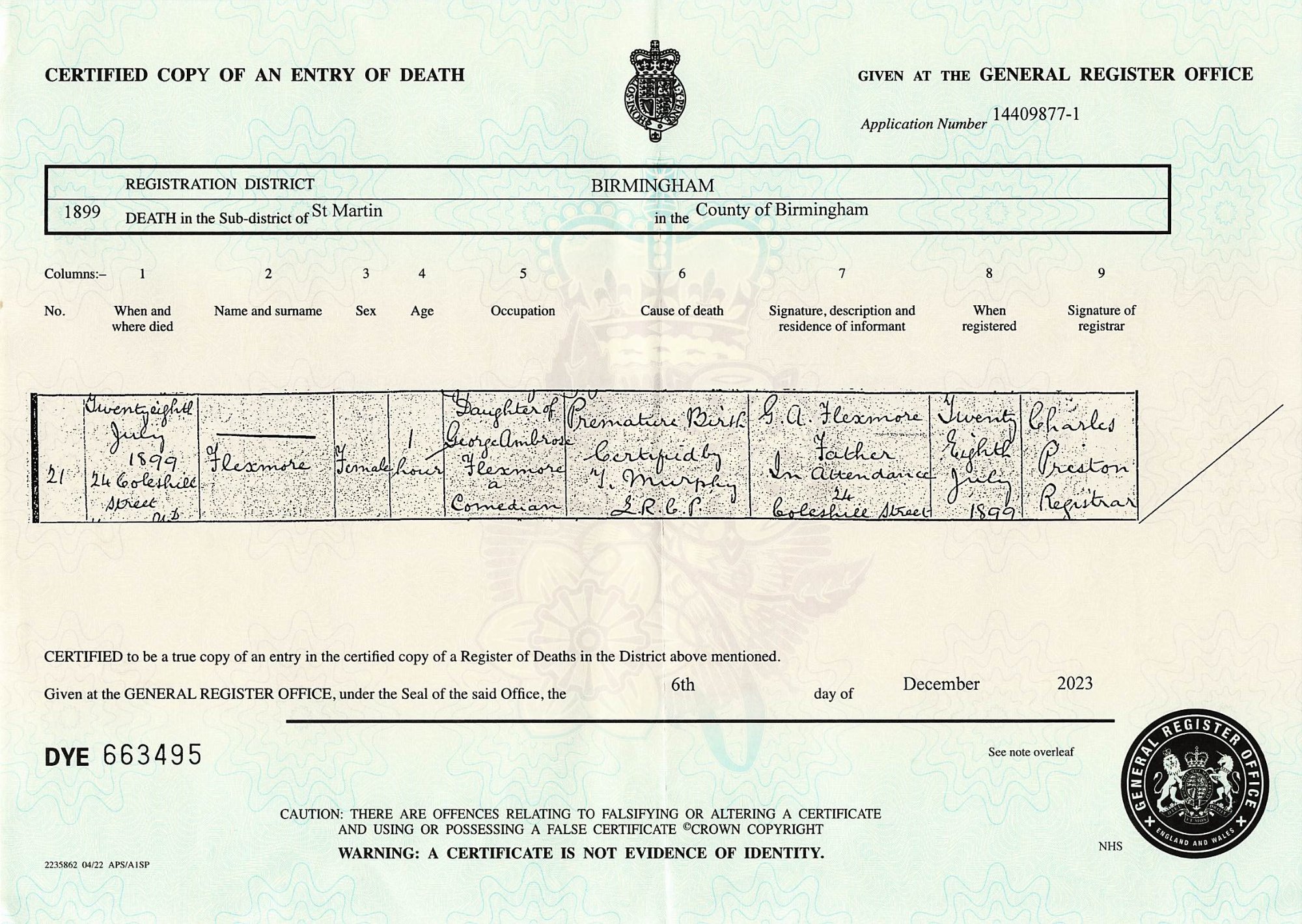
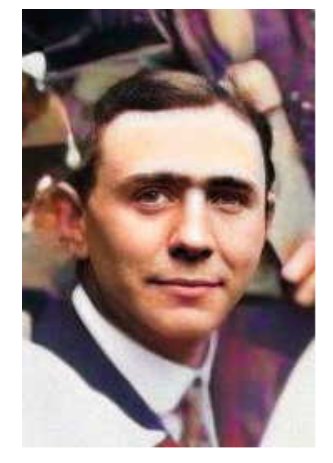
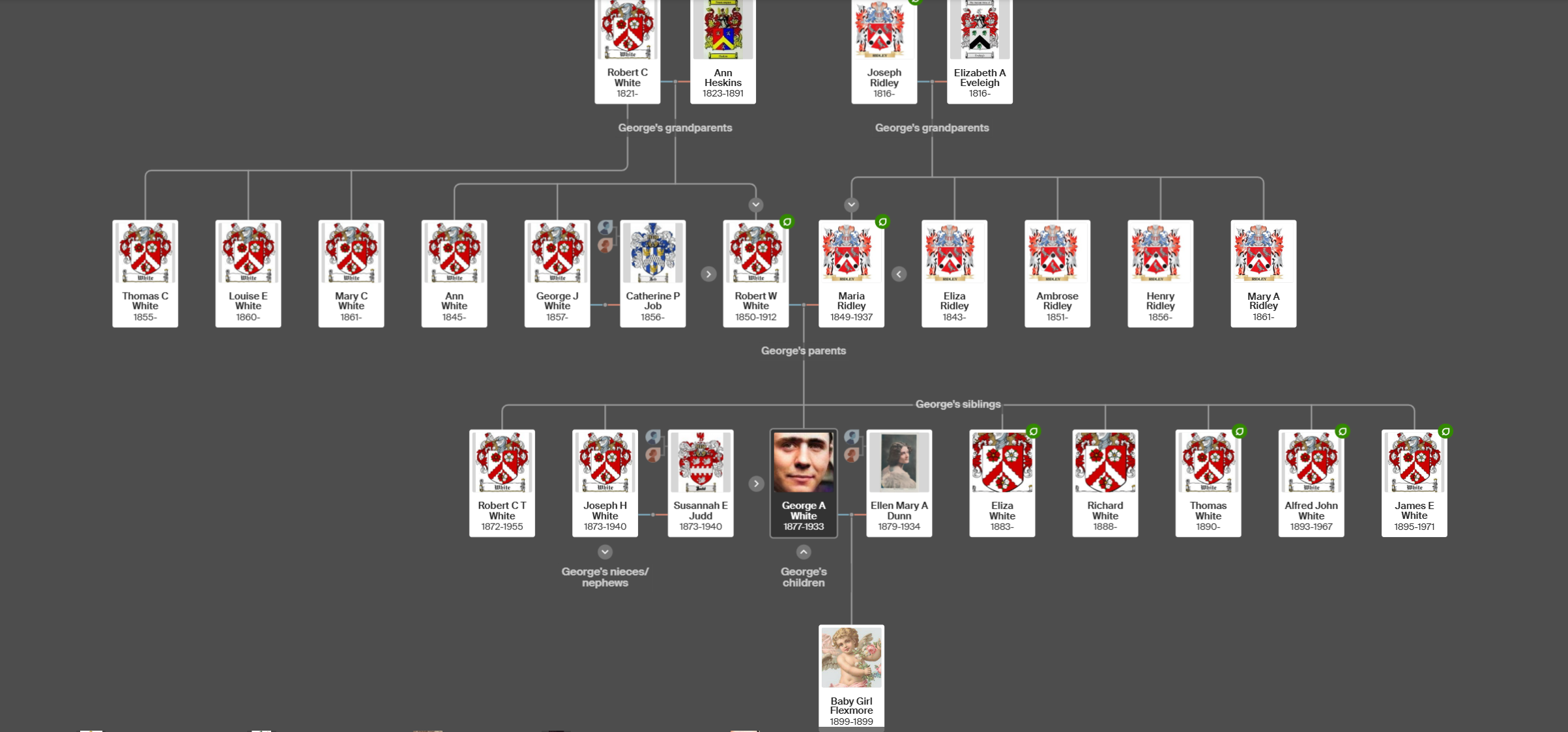
When it comes to genealogy, the expression ‘persistence pays’ holds very true. Karen and I maintained our search, until, in November of 2023, I had a breakthrough in the form of a newly digitised record. The record mentioned ‘Baby Girl Flexmore.’ When I opened it, it was a birth certificate which showed that a Lily Flexmore, formerly Dunn, had given birth to a baby girl at an address in Birmingham on 28th July 1899. Lily’s husband was listed as George Ambrose Flexmore, occupation Comedian. The certificate was accompanied by a second one - a Death Certificate for the baby, noting that the infant survived for just one hour following her premature birth.
I was very deeply moved when I learned of this tragic event. My late wife and I had also suffered the loss of a little baby girl very shortly after birth, and my heart went out to Ellen and George.
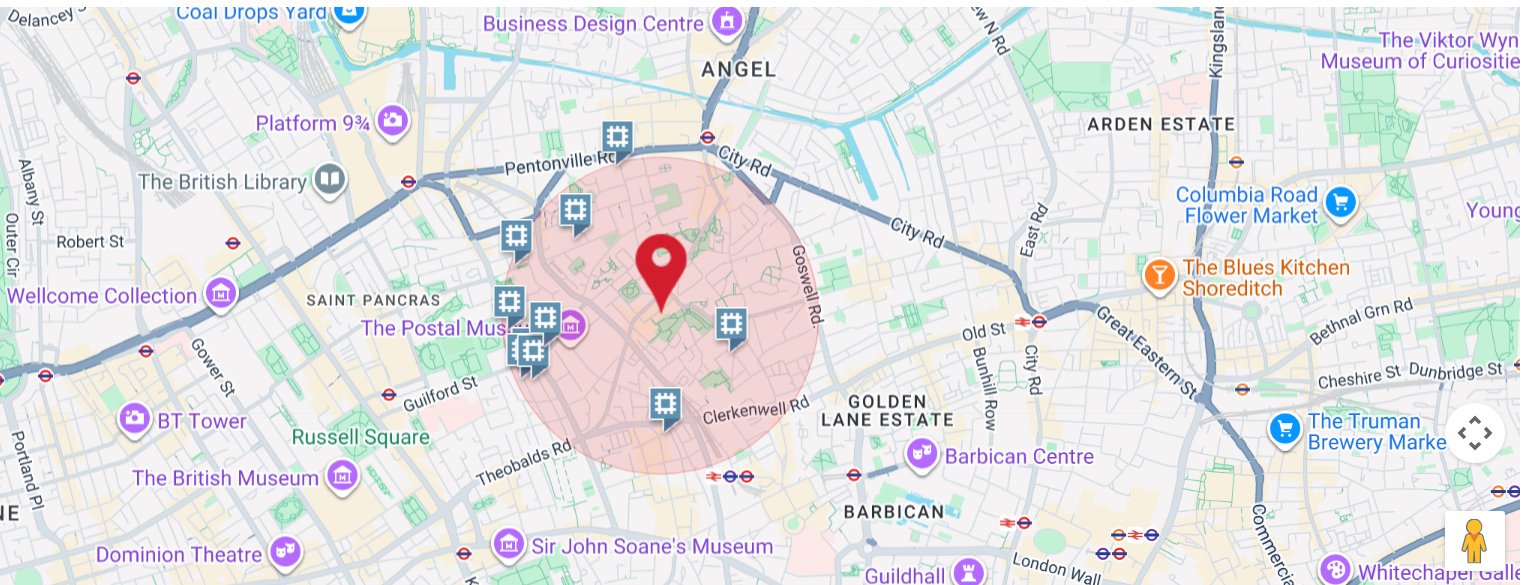
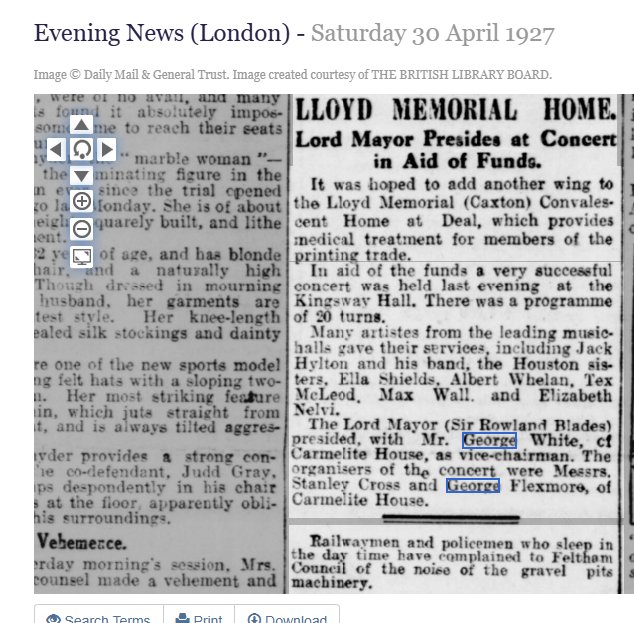
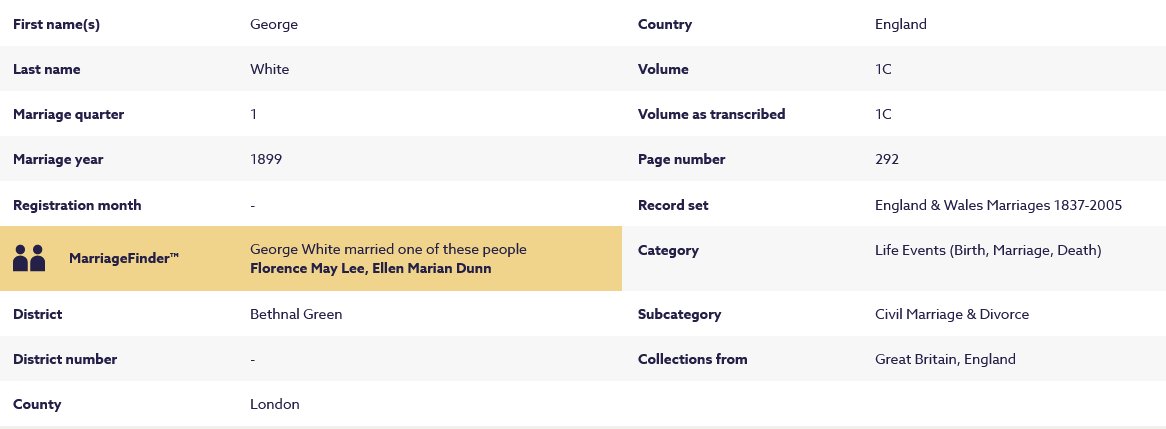
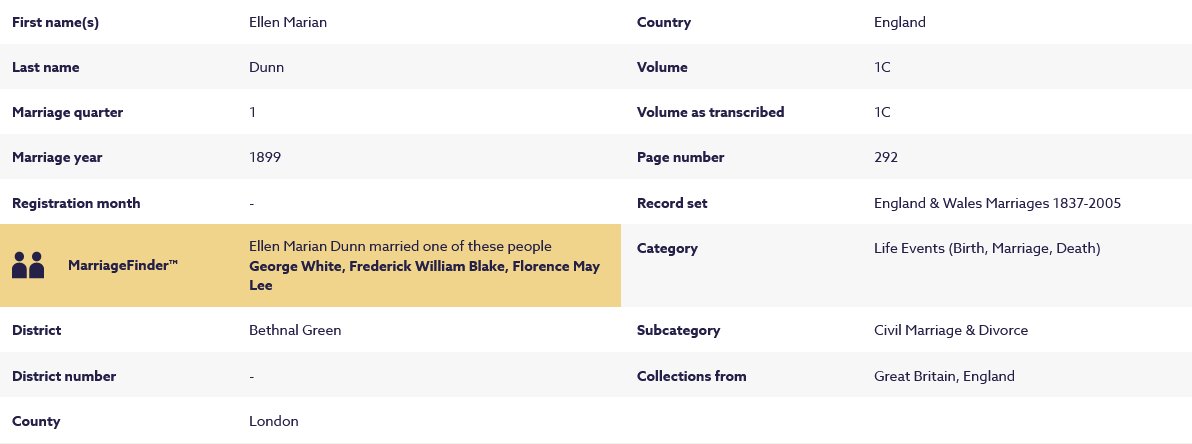
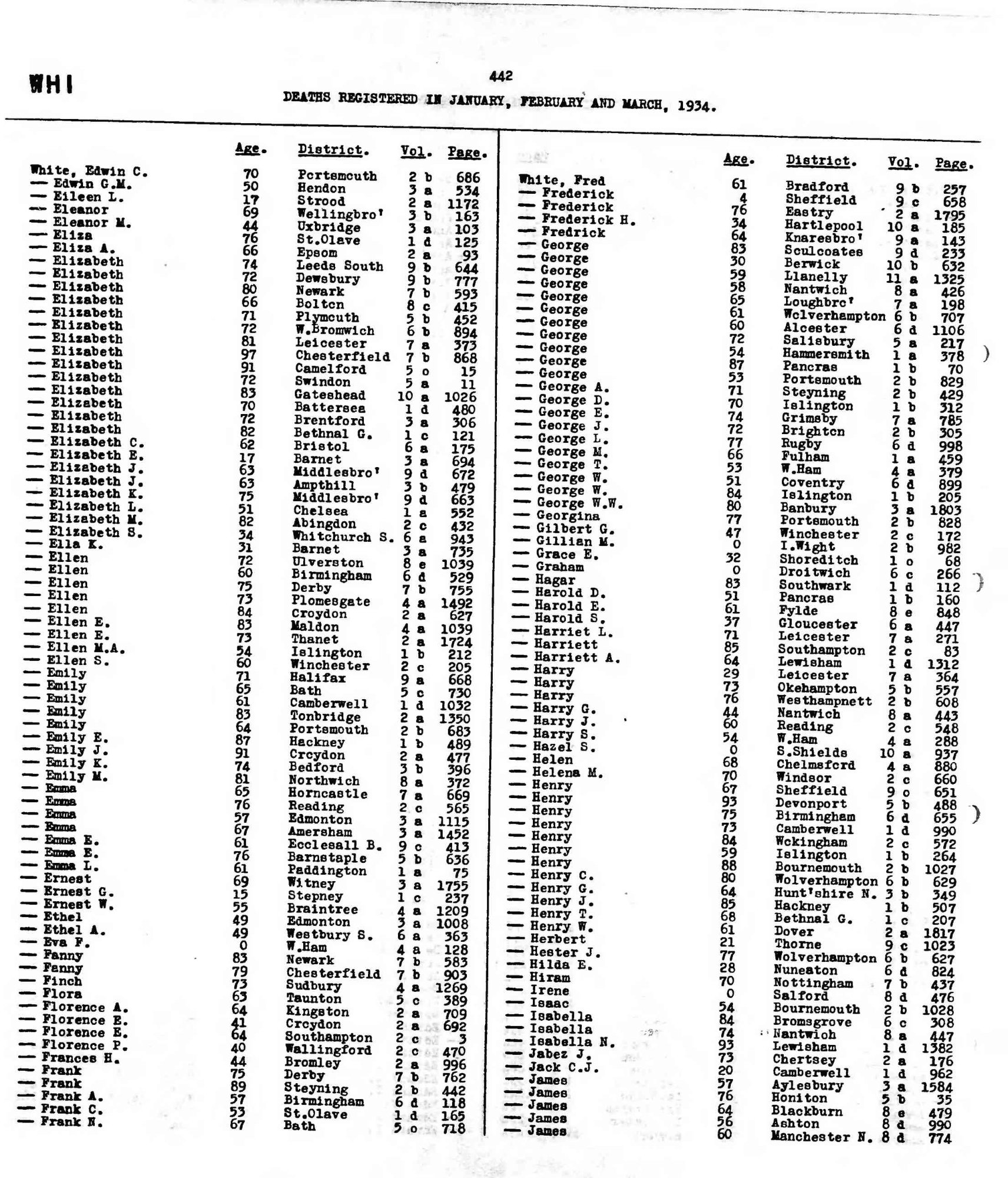
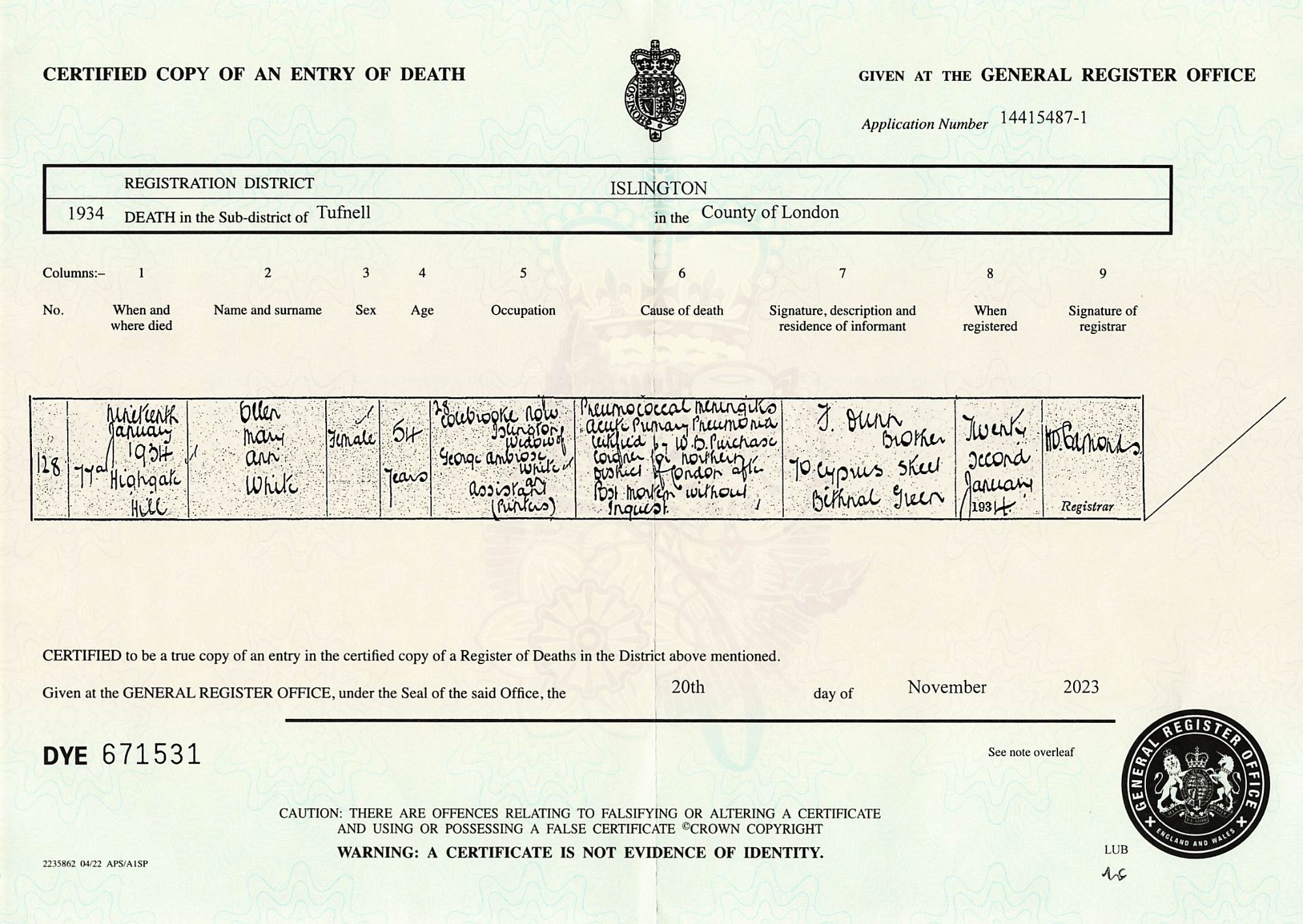
Nonetheless, this gave me proof positive that Ellen had married, and I now had the Christian names of her husband, and a possible explanation of why Ellen had chosen Flexmore as her professional name. I sent off to the GRO for official copies of the certificates in order to include them in the tree. Further searching revealed that Ellen Mary Ann Dunn had married George Ambrose White in Bethnal Green on 27th February 1899 - two days after Ellen’s twentieth birthday. I was able to follow their lives through census returns, electoral registers, and newspaper archives, and in time to find the dates on which they passed away - George on 26th September 1933, and Ellen just four months later, on 19th January 1934.
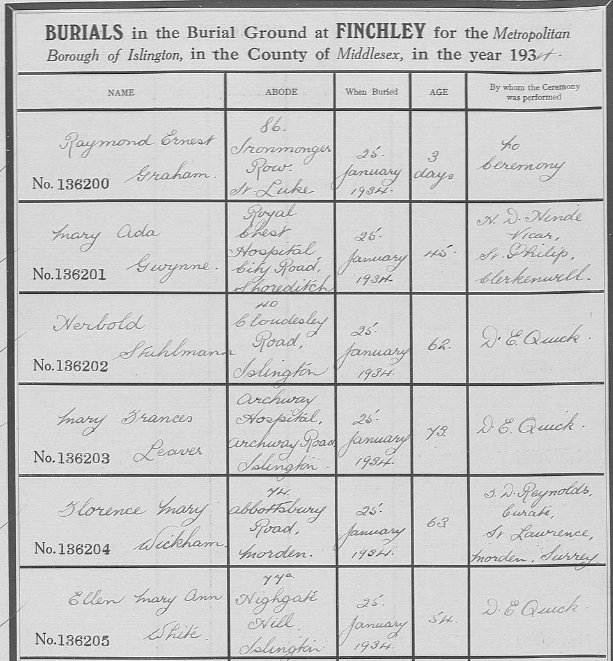
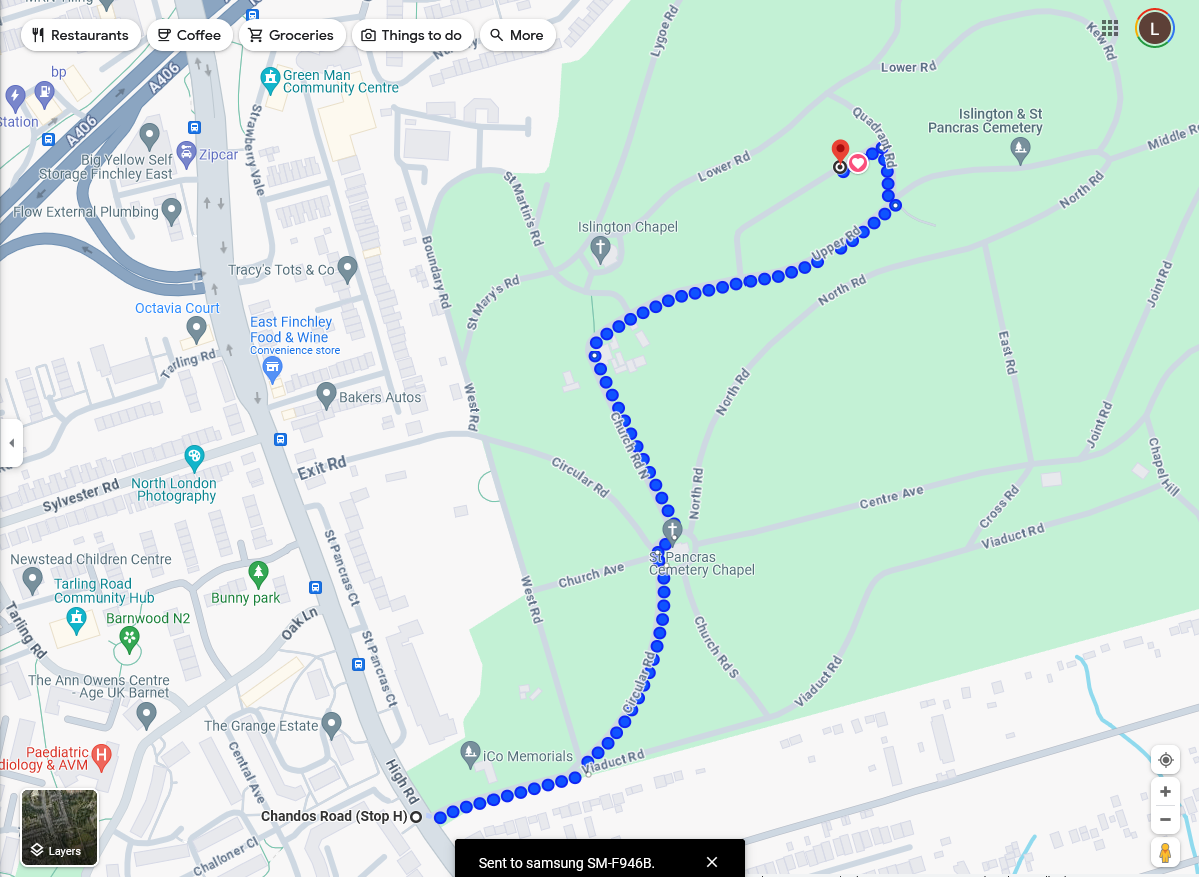
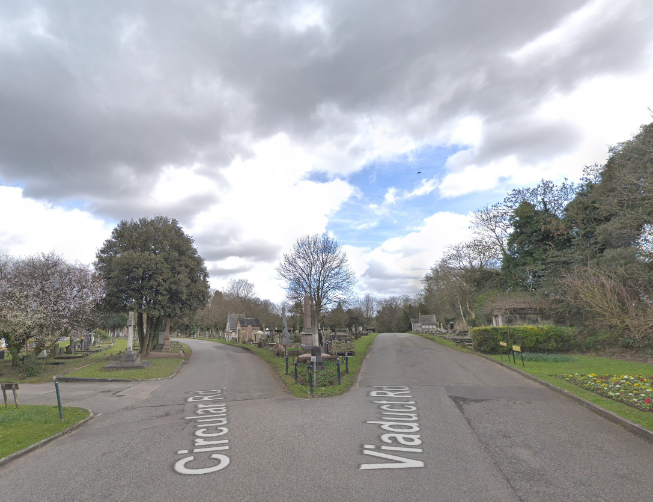
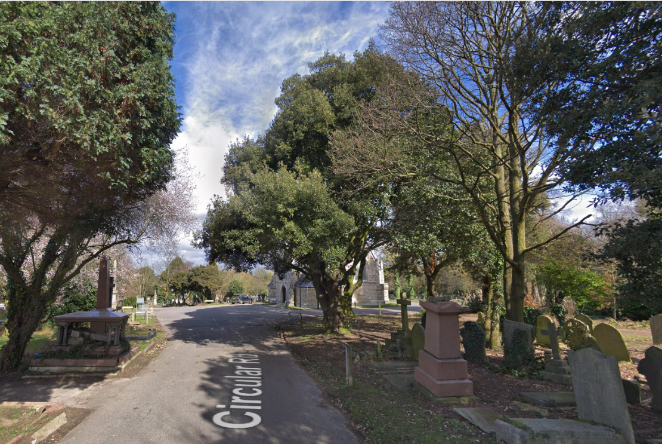
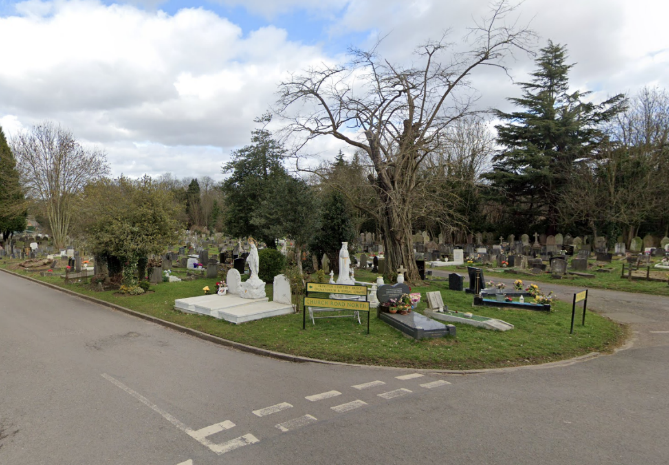
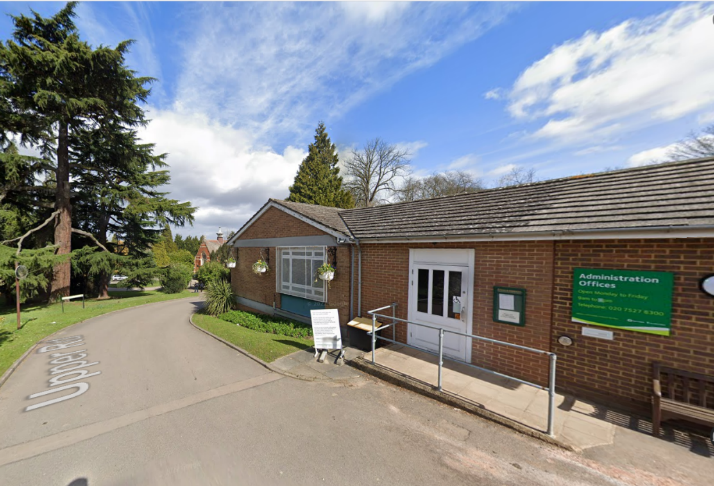
I was also able to find the burial registers for the couple. This gave me an approximate location for their last resting place, in a section of Islington & St. Pancras Cemetery. I then contacted Karen with the news. I put together as much information as possible in the form of a life-story in a single document and sent it on to her.
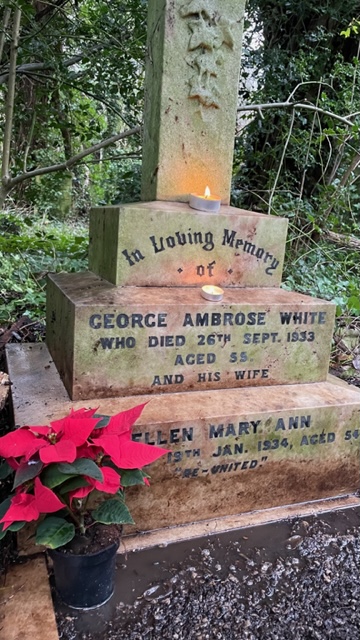
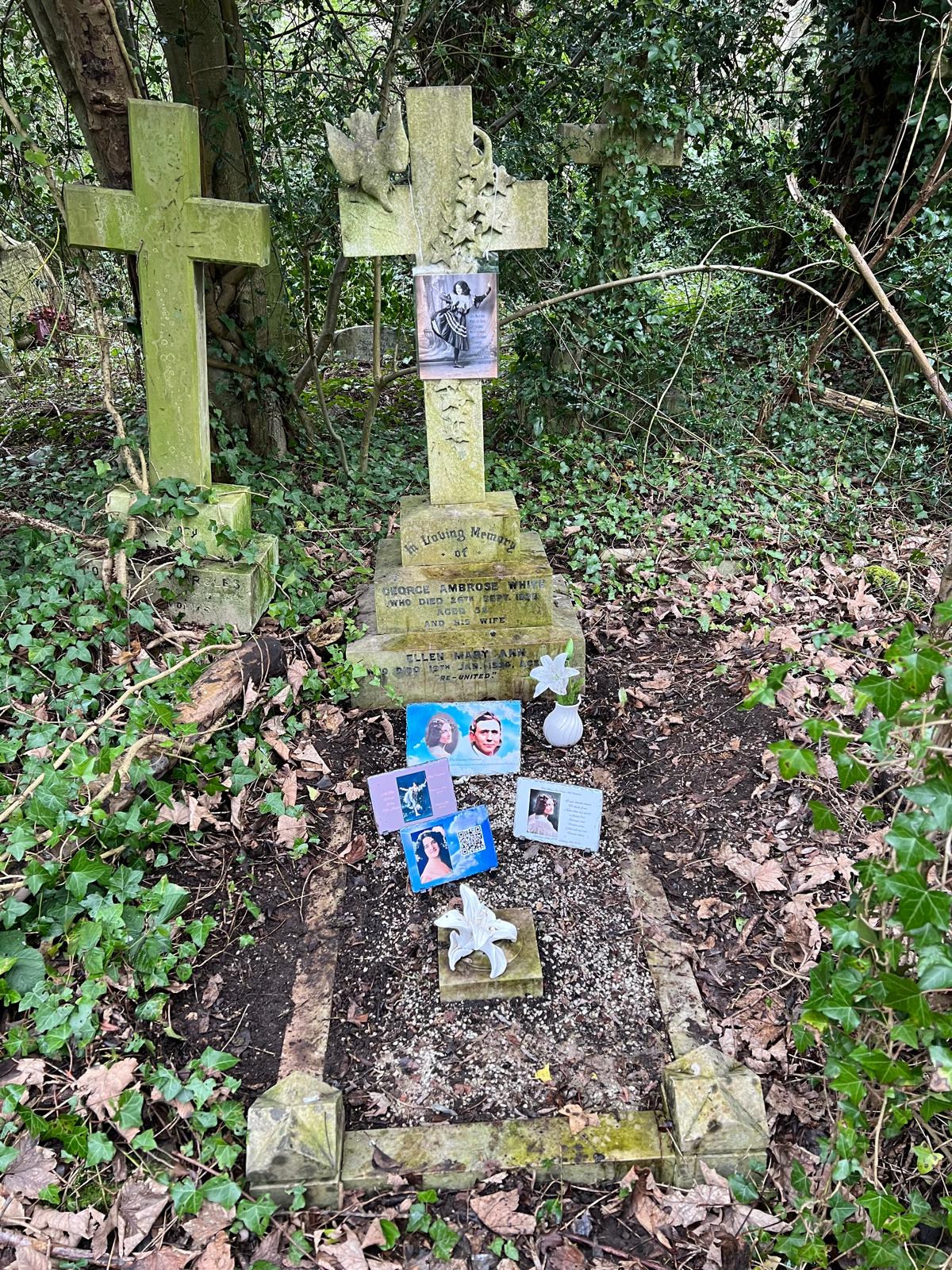
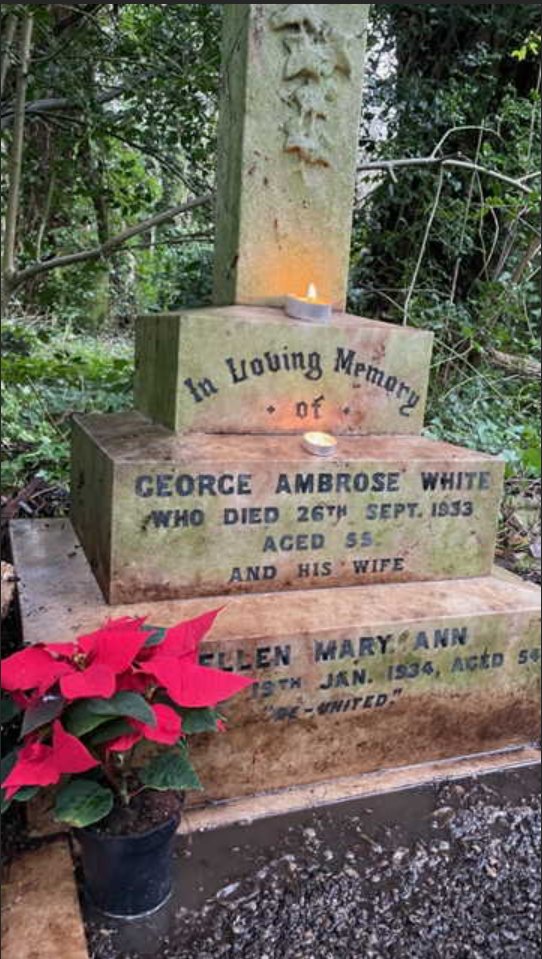
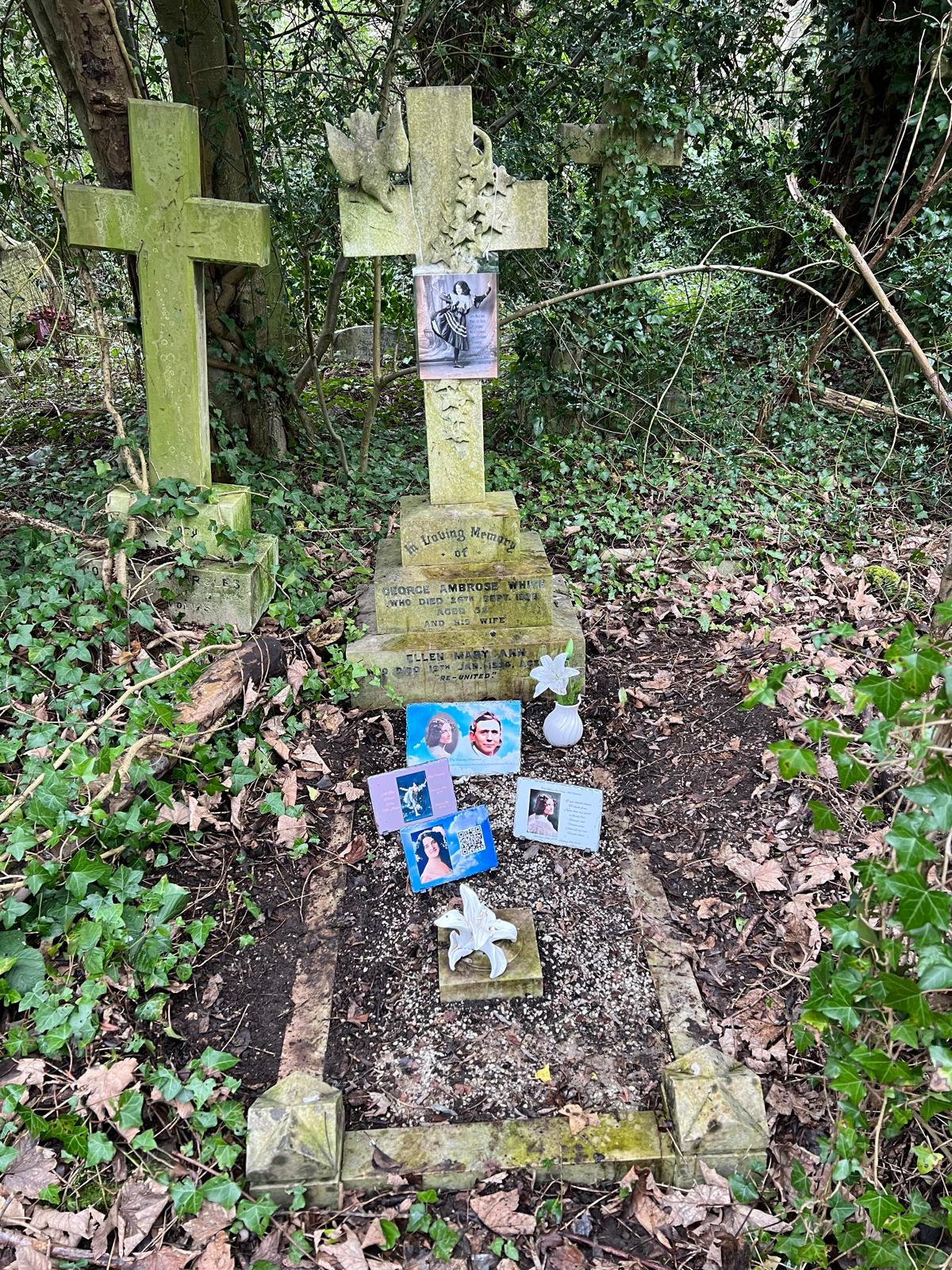
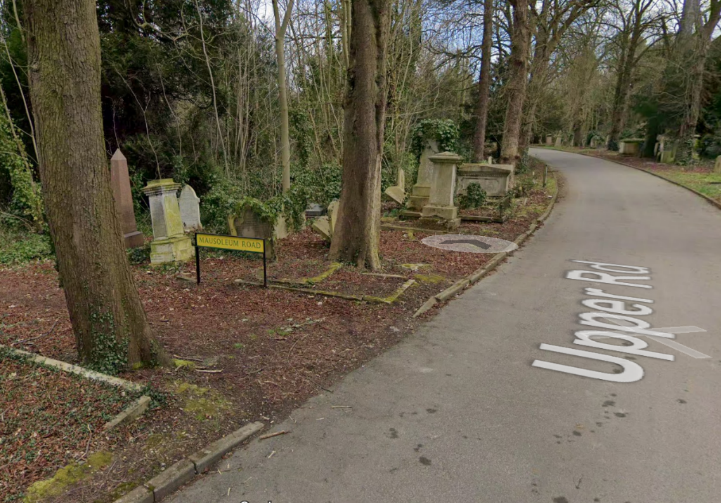
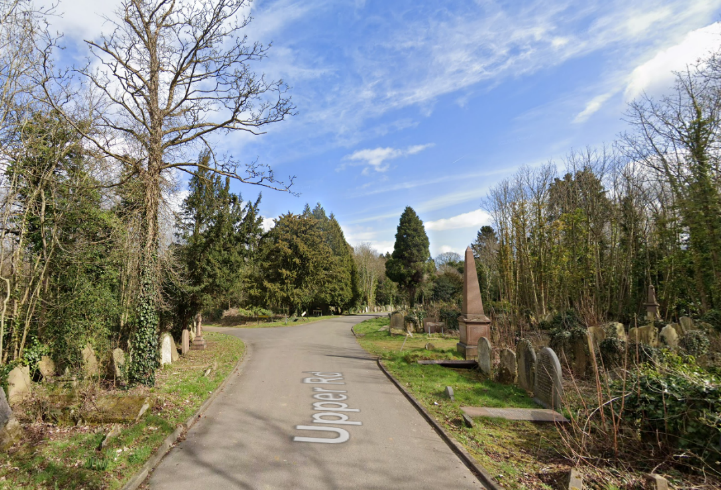
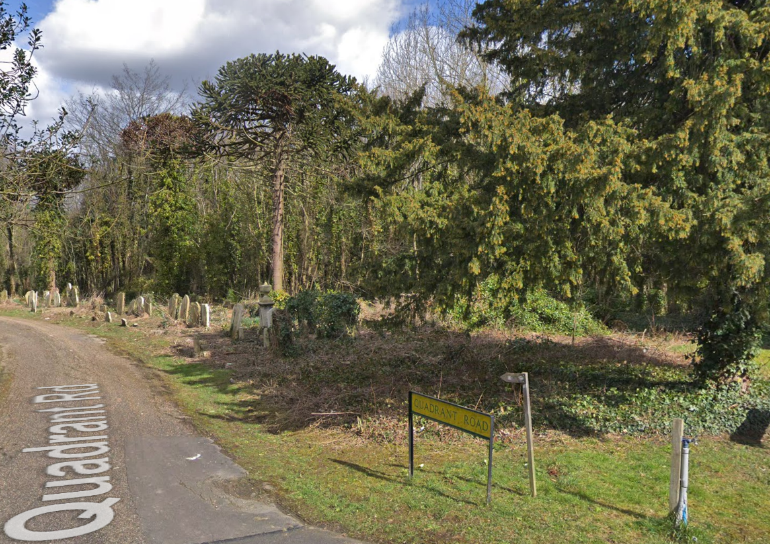
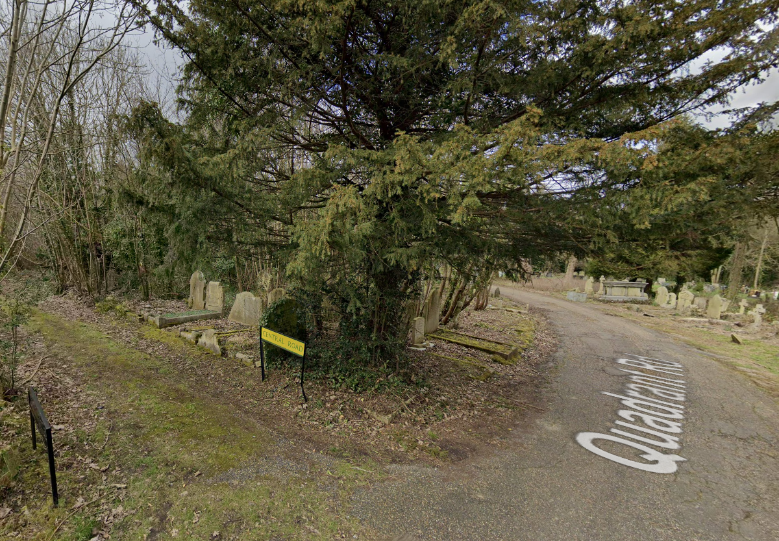
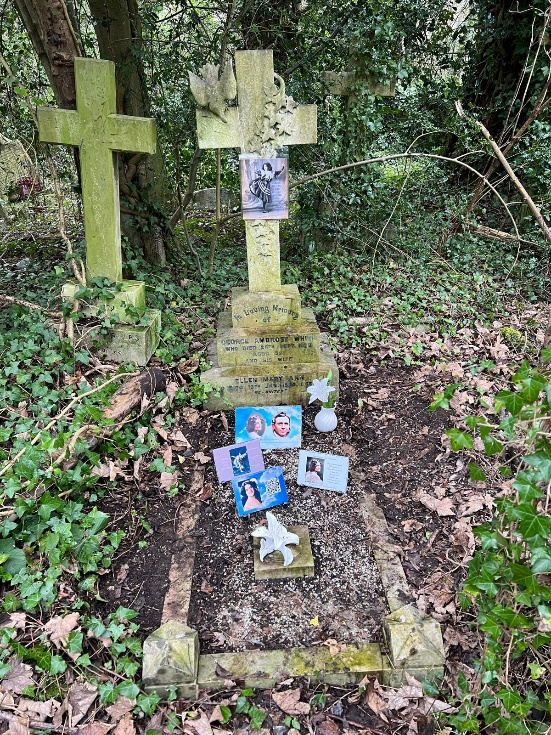
In December of 2023, Karen and her family embarked on a search of the Islington & St. Pancras Cemetery. It was an extraordinarily difficult search, since nature had spent almost ninety years reclaiming the area. But, in a moment of glorious triumph, they found the grave. It was in remarkably good condition, but the names had been almost totally concealed by a build-up of earth around the base of the stone. Only the name Ambrose was partially visible - but that was all it took for Karen and her family to uncover the full names of Ellen and George, along with the annotation: ‘Re-united.’
The stone is in the form of a tall cross, with a garland of ivy. There is also a descending dove on the cross, which is said to represent the Holy Spirit descending, often signifying that the deceased was a person of faith or that the Spirit is bringing peace to the scene.
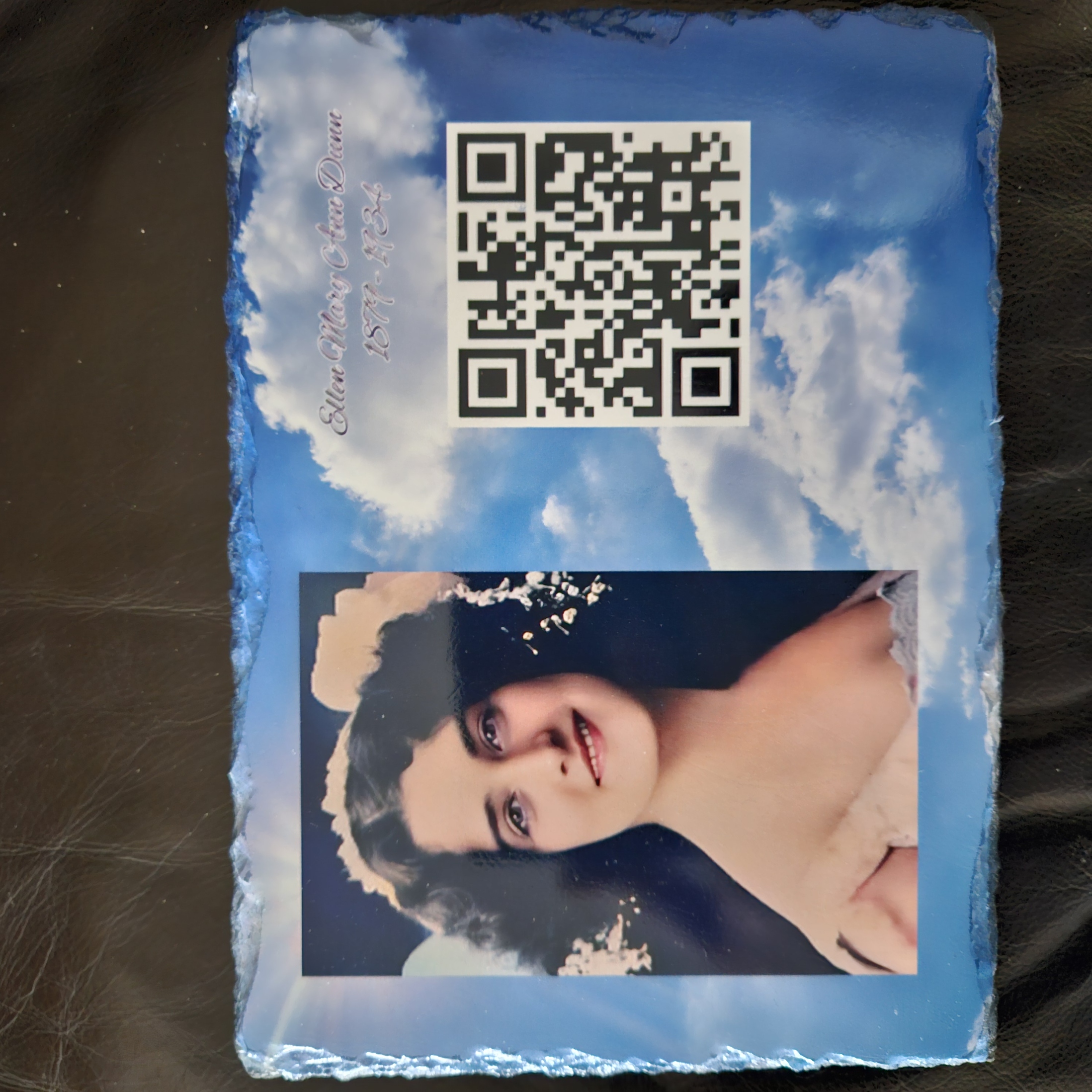
I have now visited the grave on four occasions - the last time in June of 2026, along with Karen and her cousin, Paul Duffett, whose great-great uncle was Ellen’s older brother, John Joseph Dunn (1876–1946). Paul placed a lovely image of Lily Flexmore in professional pose on the grave. I placed some illustrated slates depicting Ellen and George.
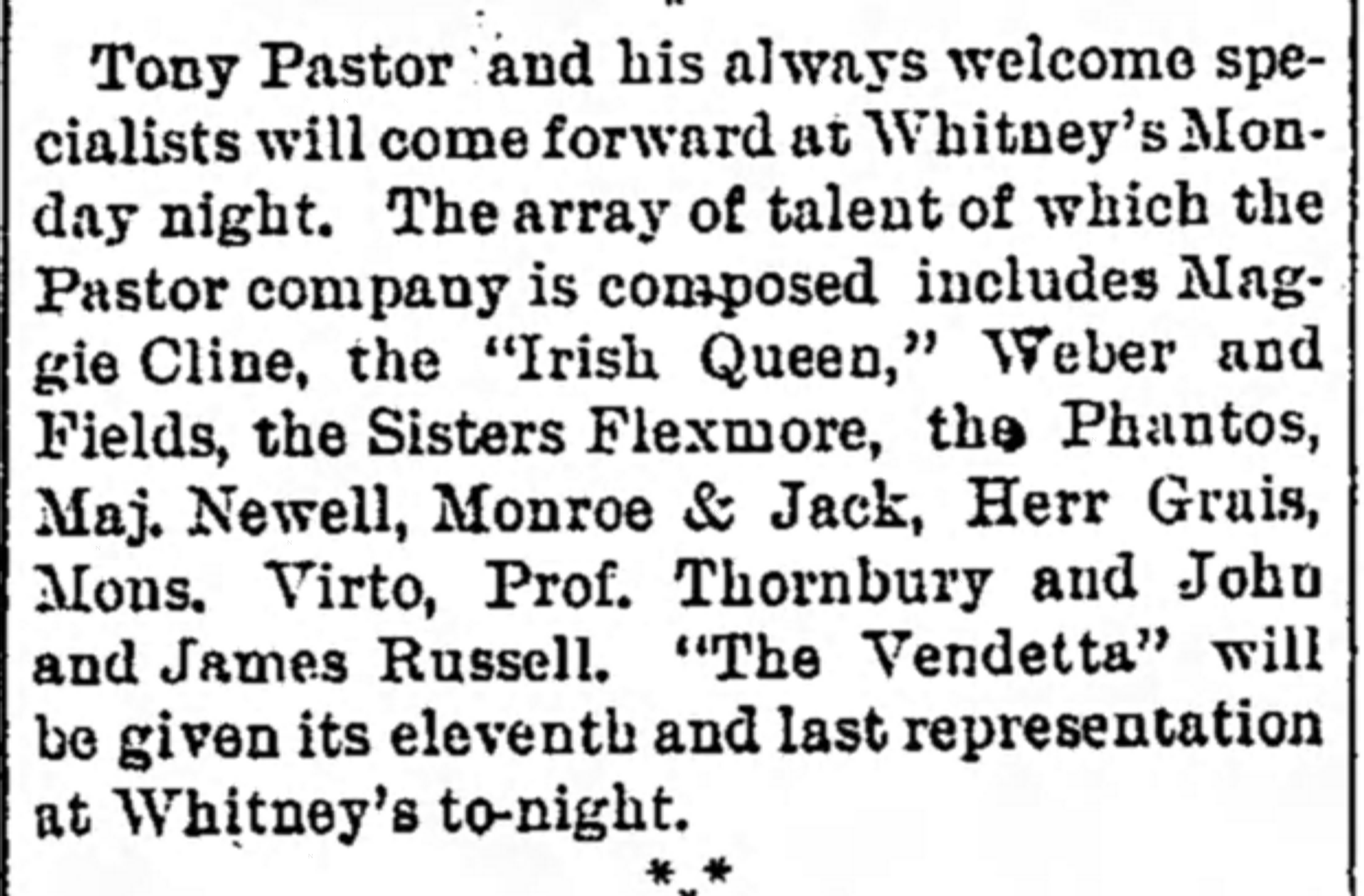
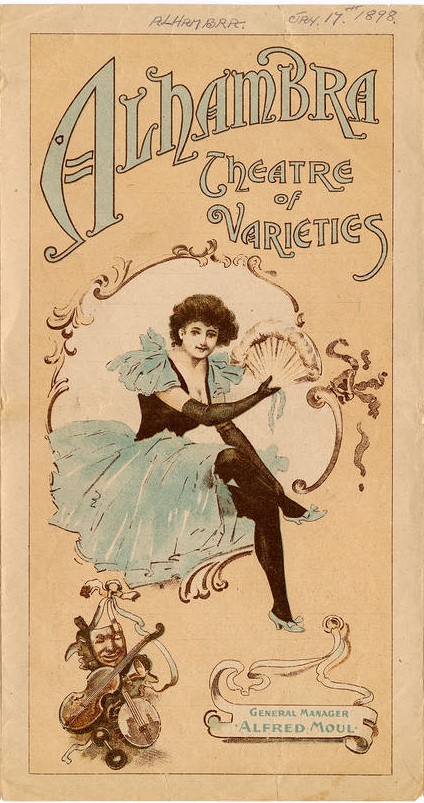
Although the search for Lily Flexmore resulted in a successful outcome, we still continue to seek out newly digitised information. For example, there is a tantalising advertisement, from the Music Hall and Theatre Review - Friday, 25th March 1898 - citing upcoming performances by Lily in Russia.
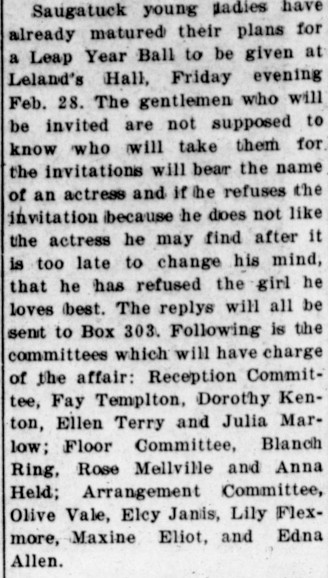
An advertisement inserted by a Travel Agent, Paul Tausig & Son, printed in Variety Magazine (Vol. 41, Issue 7, Page 32) on 14th January 1916, used the name Lily Flexmore - in a list of celebrities who had used their services - as an endorsement of the company’s steamship booking services. This was eight years after Ellen’s USA tour and may be an indication that Ellen returned to the USA. Coincidentally, there are two extended periods, from late 1915 through to March 1916 and from May 1916 to November 1916, where no UK appearances are advertised.
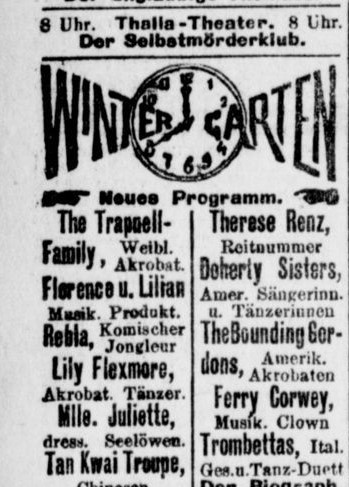
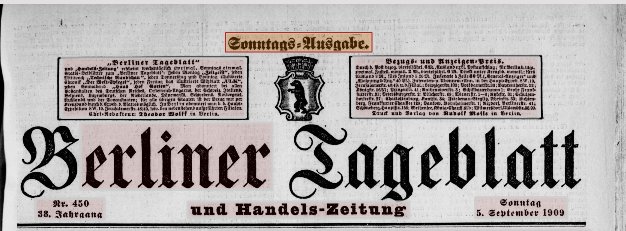
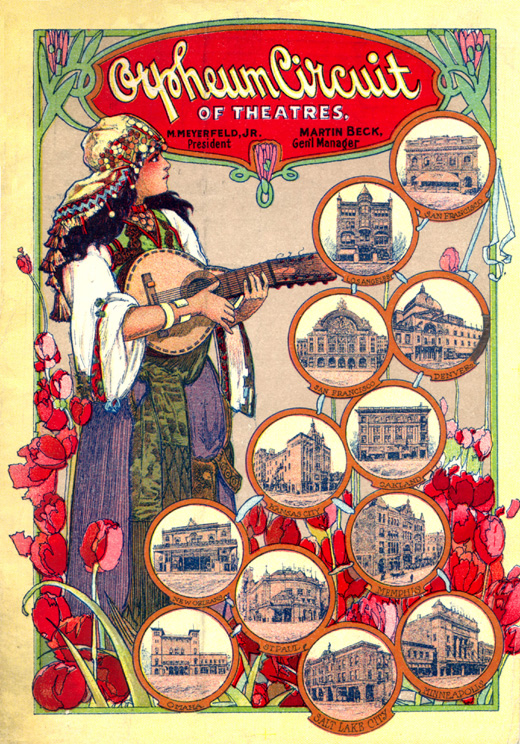
Another area to be further explored is the apparent lack of evidence of how and when Ellen and George returned from the United States. Going by Ellen’s engagements as advertised, she performed at the Dominion (Orpheum) Theatre, Winnipeg, Manitoba, Canada on 29th April 1908. On 9th June 1908, she was at the Wintergarten Theatre, Berlin, Germany. Her next British engagement was at the Palace Theatre, Dundee in August and September of 1908. Between Winnipeg and Berlin - two cities separated by an ocean and a continent - the trail goes quiet. How they made that crossing, and when, remains to be established.
We will continue to search.